Thursday, 4 December 2008
one of your classmates has been killed by a werewolf...
This quarter I’m teaching a graduate seminar on online identity, community, and group behavior. I taught it last year for the first time, but now that it’s not all new prep I’m able to have a bit more fun with it.
This week we’re just starting with identity concepts, and I was trying to think of an engaging way to get them doing something related to identity issues. When I woke up this morning, I had the idea of having them play Werewolf, which is at its core all about knowing/deducing identity based on contextual clues.
I hand-wrote roles onto pieces of postcard stock, and handed them out to the sixteen students after a very brief overview of the rules. (One or two of them had played before, but most were new to the concept.) We played a very simple version of the game—for those of you familiar with werewolf, we had no healer and those “killed” did reveal their identity upon death.
It was spectacularly successful. Most of the students were game design & development students, and listening to them process all the game theory issues out loud was fascinating and immensely entertaining. Best of all, it forced even the quietest and most introverted students to engage in discussion (and misdirection), required everyone to learn each others’ names, and created a sense of engagement and fun that’s so often lacking in grad theory classes.
In other words, today was full of win. :)
Some useful links for people wanting to try werewolf themselves:
- Rules for “Are You a Werewolf?” (wunderland.com)
- Werewolf: A Mind Game (basic rules from Zarf)
- Printable Rule Book
- Memories of a Dead Seer (great article by Jane McGonigal on werewolf at FooCamp, and strategic aspects of the game)
- Advanced Werewolf Rules (variations to speed up and/or complicate gameplay)
Saturday, 1 November 2008
using microsoft office to generate student gradesheets
For years now, I’ve been using a combination of Microsoft Excel, Office, and Entourage to record student grades and then generate gradesheets for the students. After conversation with a few academic colleagues, I’ve realized that many people aren’t aware of how helpful Office’s mail merge functionality is for this process, so I thought I’d document what I’ve been doing.
At the beginning of the quarter, I grab the students’ first and last names and RIT user IDs using our student records system. This is a little clunky, since there’s no easy import—I have to copy and paste from the tabular data on the website and then clean it up in BBEdit before importing to Excel. That takes me 15-20 minutes, after which I can easily use Excel’s concatenation functions to add columns for their email address (userid@rit.edu) and required website URL (http://people.rit.edu/~userid/imm/). I use the classlist spreadsheet to generate a web page with the student names linked to their URLs. I do this by using the mail merge function in “catalog” mode, like this:

I’ve got a standard Excel spreadsheet for each assignment that my students do. The first few columns are for their first and last names, email address, and URL, which I cut and paste from the classlist. The rest are for the various graded components of the assignment I’m grading—organization, design, content, mechanics, etc.
I grade the projects using the spreadsheet (which I can email to a grader if I’m having them do part of the work). Once all the projects are graded, I open up a Word document I’ve created that serves as the nicely-formatted gradesheet, with spaces for each of the individual point values, the total grade, and any comments from me or my grader. I used to then print these out and hand them out in class. Last year, however, I realized that I could use the merge function to send attached documents to email addresses, rather than outputting to the printer. Here’s what the document looks like, along with the merge tool window. (Click on it to see a larger version.)

Once I’ve checked it over to make sure it’s formatting properly (I can use the icon labeled ABC in the preview portion of the merge window to see what any given gradesheet looks like when output), I use the merge to email option in the last pane of the merge window. It gives me this dialog box:

Selecting “Mail Merge to Outbox” will generate email messages to each person in the classlist with an attached personal gradesheet, and will place these in my Entourage outbox. I can then check them over quickly before telling Entourage to send them.
I seriously considered switching to Google Docs this year for my grading, since it would have been easier to share spreadsheets with my TAs and graders. However, much to my amazement, Google’s spreadsheets offer no mail merge functionality, so I had to scrap that plan. I’m excited to hear that the new Office Live may give me the ability to maintain my current workflow while also allowing me to share the spreadsheets with my graders.
Wednesday, 14 May 2008
occupational benefits
One of the very best parts of being a university professor is being able to get free books from many publishers. It makes sense for them, because I’m unlikely to assign a book to my students if I haven’t had a chance to review it carefully. During the school year, however, I’m usually trying very hard to keep my head above water with the things I have to read, so I don’t take too much advantage of the benefit.
Summer is approaching, however. This is week 10/10 for classes, and next week I’ll be grading final projects and presentations. That means I’m only a week and a half away from being able to immerse myself in books that I’ve been wanting to read. So today I placed a bunch of orders—some using my faculty book allowance (some publishers, alas, don’t give freebies), and others taking advantage of generous faculty review copy policies. Here’s what’s on my reading list for June:
- Digital Culture, Play, and Identity: A World of Warcraft Reader (edited by Hilde Corneliussen and Jill Walker Rettberg)
- Ted Castronova’s Exodus to the Virtual World: How Online Fun is Changing Reality
- Henry Jenkins’ Convergence Culture: Where Old and New Media Collide
- Mark Meadows’ I, Avatar: The Culture and Consequences of Having a Second Life
- Joshua Porter’s Designing for the Social Web
- Garr Reynolds’ Presentation Zen: Simple Ideas on Presentation Design and Delivery
- Gene Smith’s Tagging: People-powered Metadata for the Social Web
- Jonathan Zittrain’s The Future of the Internet — And How to Stop It
And if I hadn’t already received a copy and started reading it, I’d add to that list
- Clay Shirky’s wonderful new book Here Comes Everybody: The Power of Organizing Without Organizations
Friday, 16 November 2007
teaching nightmare come to life
So, I’m sitting at home at 1:00 this afternoon, grading final projects, when my phone rings. It’s one of my students, and he asks me where I am. At home, I tell him…the exam’s not until 2:15pm.
No, he tells me, it’s at 12:30pm. The whole class is waiting at the classroom.
o.m.f.g.
Happily, I’m already showered and dressed. I toss on a coat, grab my computer, and fly out the door, arriving on campus 11 minutes later. They’re now taking the exam, which, thankfully, usually only takes students 45min to an hours to finish.
This is the kind of thing I have bad dreams about. (Though as one of my colleagues pointed out, it could have been worse if course evaluations weren’t already finished…)
Tuesday, 4 September 2007
things that can go wrong on your first day of teaching
- You can spill coffee all over yourself on your way to your first class of the day (luckily I was wearing a dress with a floral print that camouflaged it perfectly)
- You can forget to bring the stupid mac video dongle to connect to the projector (borrowed one from a colleague in the nick of time)
- You can have both projectors in your classroom go dead just as your second class is about to start (but they could bring up the syllabus on their lab computers)
- You can forget how utterly exhausting teaching is, and find yourself tired nearly to the point of tears just as you’re realizing that your kids start school tomorrow and they haven’t finished their summer reading packets (done now)
- You can foolishly upgrade the software powering your course blogs (they’re fixing the bugs I found as I speak, however)
On the plus side, my two freshmen classes this fall seem to be full of high energy students who will make teaching fun. Elouise and I aren’t on opposite schedules this fall, so we get to see each other lots. And the influx of gaming faculty into the department is changing the tone of our hallway in a very good way.
And in unrelated news, Lane’s full-arm plaster cast was removed from his right arm today and replaced with a waterproof forearm cast, so he can now shower! w00t!
Tuesday, 29 May 2007
interstices
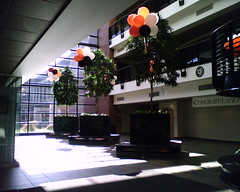 I stopped by campus this morning to move a monitor from my office to Weez’s, and as I left the building I was struck by how empty the atrium was. The balloons were still attached to the ficus trees, the “congratulations” banner was still strung across the wall, but the building was close to deserted. Staff were working quietly inside their offices, but the bustle of students and faculty—which reaches near fever-pitch during the last weeks of the quarter—was absent.
It reminded me of how it used to feel when I was an undergraduate student in Ann Arbor, where I often chose to spend the summers working and playing with friends. There’s something almost magical about what happens in the spring when the swarm of students leaves for the summer. The strikingly quiet buildings and walkways invite you to slow down, to look around at how beautiful a campus can be, and to notice that while you were cloistered in classrooms and offices spring had arrived in all its glory.
For professors who are also parents, late May and June are particularly precious—because the kids are still in school, but we aren’t. So today I’m soaking up this brief, peaceful interlude between the just-finished chaos of exams and paper grading, and the impending excitement of heading to Seattle on Saturday.
categories: academia | seattle | teaching | travel
Monday, 19 March 2007
the best part of teaching...
…is when, in the second week of the quarter, you realize that you have a lot of really talented students in your classes.
Yay!
Sunday, 11 March 2007
cscw course syllabus
The break between fall and winter quarter this year was two weeks, which provided just enough time to relax a bit and then do a reasonable amount of course prep.
The break between winter and spring quarter, however, was only one week—and I didn’t have my grades done until Monday of break week. That means I’ve had basically no down time, because I’m teaching a brand new class next quarter that’s also a distance learning class—meaning that the material has to be much more organized than I might be able to get away with in a lecture format.
As a result, I’ve been cross as a bear for the past few days, as I struggled to get my mind around how to present the enormous topic of CSCW and Groupware in a mere ten weeks of instructional time. Blech.
On the plus side, there were a couple of people who had graciously put their syllabi for similar classes up on the web—most notably David McDonald at UW, and Joe Konstan and Loren Terveen at Minnesota. I drew on their work, as well as my own knowledge of the field, to come up with my syllabus. I know I’m taking on an awful lot of topics, but it’s really intended as an overview rather than an in-depth assessment of any one aspect of CSCW.
I’ll be filling in more details (particularly readings and lab assignments) over the next week, but at least the basic structure and the first week’s materials are available in time for the students to start work on them tomorrow.
Monday, 5 March 2007

Sunday, 4 March 2007
help wanted: ta for rit web design class
I need an RIT student (graduate or upper-level undergraduate) to be a TA for my web design class next quarter. You have to have taken 4002-409 or 4004-737 (and gotten an A, natch), and you have to be enrolled as a student next quarter. My section meets M/W from 4-6pm.
Contact me at my my RIT email (ell at the standard mail dot rit dot edu) if you’re interested.
Monday, 26 February 2007
things i'm doing instead of blogging
- responding to the slew of last-minute messages from students panicked about exams and projects* grading final exams and projects
- restarting the afghan for Lila Rose, because I didn’t like the yarn I was using and the way it wouldn’t lie flat
- dealing with the chaos of kids home all day because of February break
- reading and reviewing grant proposals for a meeting later this week
- catching up on Battlestar Galactica episodes that were on the verge of being deleted from our list of recordings
- leveling my troll priest in WoW—I expect she’ll be 70 by the end of this week
I don’t expect blogging to resume with any regularity until grading, proposal reviewing, and leveling are all finished.
Wednesday, 24 January 2007
collaborative exam creation
I tried an experiment this quarter in my Human Factors class. I set up a SocialText wiki, extended invitations to all of my students, and told them that 10% of their midterm grade would be the quality of their submissions to the wiki. Everyone was expected to submit a minimum of 10 points worth of questions to the wiki, and I promised that once the submission deadline had passed, only questions on the wiki would appear on the exam.
Overall, the quality of the questions provided by the students wasn’t great. Many were poorly worded, and they didn’t cover the full range of topics we’d covered in class. However, I was able to extract a sufficient number of questions (some with wording changes to clarify them) to create a full exam, which they took today. Here’s what the grades looked like:

That’s just about a perfect textbook (I didn’t mean to imply that as a teacher I want my students to not all do consistently great work…) curve from a pedagogical standpoint. And the grades matched my expectations, for the most part, in terms of how individual students would perform. So I’d call this experiment a success.
I will modify the process for the final exam. First of all, I’ll provide a little more structure to the page before they start adding questions. I’ll create specific topic headings associated with lectures and readings, so that they can see which areas need to have questions developed. I’ll provide a few questions to “seed” the page, so they can see examples of well worded questions. And I’ll moderate the page a bit more, marking questions that I’m likely to use in some way. I may even add a few questions of my own to supplement theirs. The key thing is that I don’t want them wasting time studying for questions that are poorly worded, since that’s not a good use of their time.
I’ll report back after the final exam in February.
(Update: I’ve made the wiki publicly readable, though only students can edit it.)
Thursday, 14 December 2006
grading as a text adventure
Oh, this is so wonderful!!!
From eye of a cat’s LiveJournal:
>look at stack
It's not getting any smaller.

>pick up essay
You lift one essay off the pile.

>read essay
With trepidation, you lift aside the cover sheet. Suddenly,
the world around you  seems to melt away...

Hell
You are in a maze of twisty little paragraphs, all alike.
The path ahead of you is littered with sentence
fragments, left broken and twitching at your feet as
their pathetic spaniel eyes implore you to put them
out of their misery. Dangling modifiers loop happily
through the branches overhead. In the distance, that
sound of undergraduate feet has turned into a heavy,
erratic thwump - swoop - THWUMP you recognise
immediately - it's a badly-indented long quotation,
and it's coming  closer.
Go there. Read it. What a treasure!
(Thanks, Steve!)
Thursday, 16 November 2006
Monday, 9 October 2006
midquarter blues
It’s the halfway point in our quarter (RIT is on an eleven-week quarter system).
Sandra Boynton’s wonderful drawing sums up how I’m feeling at this point:

(The image is scanned from a notepad I bought years ago. Yes, it’s probably a copyright violation to post it. But so far as I know, it’s out of print—otherwise I’d point you to a licensed version. If you have kids, however, and don’t already own most of her board books and audio recordings, you must must must go to her site and acquire as many as you can afford. These books were a staple of my kids’ childhood, and they still make me happy. And the music…well, go listen for yourself. It’s fantabulicious. And while you can’t actually listen to cuts from Grunt*, you should buy it anyways. Trust me. )
—
*I just noticed this great line on Sandra Boynton’s bio page: “I like to think of Grunt as the culmination of a lifetime of joyfully squandering an expensive education on producing works of no apparent usefulness.”
Monday, 4 September 2006
Thursday, 6 July 2006
online professor rating systems
I see from the wiki for BarCampRochester that someone has proposed a session to talk about the online professor rating system. I wish I could go. I’d love to ask some hard questions about these systems generally.
For example, would the people who champion these systems be just as enthusiastic about a publicly accessible “student rating system” that let professors share their opinions about students?
I’m really torn about these rating systems. I understand the desire and the need for them. I remember using a print version of them when I was an undergrad at Michigan. But too often the systems I’ve seen on the web turn into the worst example of online character assassination. I may not be the best professor there is, but how helpful is it to have a system that lets people write (as I found on one site several years ago) “She should be chasing chickens on a farm, not teaching information technology.” Yes, I can laugh at the absurdity of it. But I’ve seen some that were far worse and more damaging than that. Comments about people’s sexual preferences, their physical appearance, and more.
As soon as you allow anonymous free-text commenting, you get the worst of what people have to offer. And unlike in-class evaluations, where you get a full sample of student views—good, bad, and indifferent—on these opt-in systems you tend to get comments only from people with the strongest of opinions, skewing the accuracy.
If these professor rating systems are inevitable, what checks and balances can be put in place to keep them from being overrun with personal attacks? Is it realistic to have content editors? To limit to a preset list of comments? It’s not reasonable, I think, to put the burden on the professor to police his or her own evaluations.
What if it were turned around? What if professors could warn each other about problem students—the ones who regularly fall asleep in class, the ones who consistently cause discord in group projects, the ones whose grandmothers have died at least six times since their freshman year? And what if these systems were as publicly available as the professor rating systems? Is that somehow worse? If so, why? (I can think of some reasons, but I think it’s a valuable exercise to discuss this.)
Tuesday, 4 July 2006
graduate cscw class this fall at rit
This fall I’m going to be teaching a graduate class on CSCW—computer-supported collaborative work. In many ways, CSCW is the academic field of social computing, although social computing goes well beyond collaborative work.
As a result, I’ll be covering not just the more traditional forms of CSCW (groupware, email, etc), but also the newer forms of social computing that are becoming increasingly influential in business contexts—blogs, wikis, social networking tools, social bookmarking, and more.
Right now, the course only has three students enrolled (in part because it’s seldom offered, and people don’t really know what’s covered in it), and I need ten in order for it to run in the fall. So if you’re an RIT graduate student (or advanced undergraduate, or even a colleague) interested in a distance-learning class on social technologies, please consider enrolling in 4002.892.90!
Later this week I’ll work on putting up a tentative course outline, and I’ll post an update when that’s available. (I need to get my MT courseware updated first.)
Sunday, 28 May 2006
graduations aren't always goodbyes
I was too tired last night to write everything I was thinking about graduation—and I knew I was going to have to get up at 4:30am to catch my 6:45am flight home. But the airport is nearly deserted this morning, and I flew through security, leaving me with free time (and free airport wifi, one of the many nice things about Rochester) to follow up on my last post.
During my first few years at RIT, I thought of graduations as goodbyes. I’d had students for a class or two, taught them what I could, and then they were gone. But over the years, I’ve realized that with the best students that’s not the case. There are many students whose graduation has marked the passage from student to colleague, and whose friendships I treasure. They’re the ones who don’t think twice about calling me Liz instead of Professor Lawley, who still send me email updates about their newest job, who show up in my IM buddy list, who add me as a friend in Facebook, who post comments to my blog, and who even have my cell phone number.
Students like Jared Campbell and Jon Dunn, Eric Willis and Brendyn Alexander, Chris Blessing and Jay Bibby. (And yes, I know those are all men’s names. That’s the result of teaching in a department that averages fewer than 5% women in its freshman class. There have been women who made a difference in my life as teacher as well, though. Pooja Kapoor, Beth Levine, Katie Giebel, Sayali Sakhardande, Sara Berg, Tara Parekh, just to name a few.) Not all of them were straight-A students (though many were). But every one of them is someone I’d recommend without hesitation for a job, because of their creativity and initiative, their integrity and intelligence.
It was Jared who taught me that my students can be as aware of my personal ups and downs as I can be of theirs—I’ll always remember the evening that he stopped by my office to see if I was okay. I was surprised by his question, and wondered aloud why he was asking. “I read your blog,” he replied, “and just wanted to make sure you were okay.”
It was Erhardt who made me aware of just how much an astute observer can learn about a person from their bookmarks, when he stopped by my office nearly two years ago to ask with concern whether I was leaving RIT. I couldn’t imagine what had made him ask that—until he mentioned that he’d seen the bookmarks I’d listed for “homeschooling” and “Seattle” on del.icio.us. (I’ve been a bit more careful about what I do and don’t put on social bookmarking sites since then!)
Brendyn helped remind me of just how much raw talent and enthusiasm can accomplish, and how much of an impact we as professors can have on shaping that. He bounded into my life (and Elouise’s) at an advisory board dinner his freshmen year, as full of energy and curiosity and affection as an overgrown labrador puppy. It’s been a gift to watch him grow over the past four years, from ‘sycophant’ (not really, but that’s a long-standing joke) to self-assured young man with a Microsoft job offer in his pocket. I learned a lot about courage from both Brendyn and Jon, both of whom had to face some challenging situations during the time that I knew them.
Eric showed me how gracefully someone can make the transition from student to employee to colleague. In what felt like the blink of an eye he went from being a cocky student in my web design class to being the best student grader I ever had to teaching as an adjunct in our department while running (and growing) the software development team for a local business. I spent an hour over dinner on Thursday evening trying to recruit him onto my team to develop a new social application, and I’ll consider myself lucky if he can find a few hours of free time in his schedule to work with me.
Chris Blessing was a lesson to me, early in my teaching career, that some of those students with a hefty dose of attitude have it for good reason. At a time when the web was still relatively new, and most of my students wouldn’t have known an HTML entity if it bit them in the ass, Chris coded (and designed) circles around not just the others in the class but me as well. I didn’t admit it at the time, of course (those Jedi mind tricks are important for surviving as a teacher), but he taught me some humility. (Yes, Eric, you did too. But Chris did it first.)
Jay reminded me that my students could take the seeds of an idea I’d given them and grow it well beyond anything I could have done. He started his first blog in my class, but then went on to create one of the most widely-read blog sites on casual games, Jay Is Games, which probably gets more hits in a day than any my sites gets in a week.
A few weeks ago, I got an email out of the blue from a student who’d taken a class from me years ago. We hadn’t stayed in touch, but he was writing to let me know how much of what he’d learned he still used every day—and to ask if I had any talented students I wanted to send his way to hire. And few weeks before that, an article on web design popped up in my del.icio.us links with a title that looked familiar…it turned out to be written by one of my former students, and it was clear evidence that what he learned in that class had stuck with him. A good reminder that influence in the classroom can extend well beyond it.
There are others, of course. Far more than I’ve listed here. Each fall when I walk into the lab for my freshman multimedia class, the new students lined up behind the computers, full of promise and potential. But the friendly ghosts of their predecessors live in those labs, as well, reminding me that when I see these freshmen file past me years later, they’re not necessarily walking past me and out of my life. Graduation doesn’t have to mean goodbye.
Saturday, 27 May 2006
choosing to give
A lot of people have asked me recently if I’m planning on going back to RIT at the end of my sabbatical—or if, having tasted the sweet nectar of well-funded industry research, I might be tempted to stay in Seattle. I decided a few weeks ago that I was going to return to Rochester, but I had some lingering doubts and fears in my mind about whether I was making the right choice.
This weekend I flew back to Rochester for a few days, primarily to attend RIT’s commencement ceremonies. For the first day or two, I did have some second thoughts about my decision. Departmental politics were running rampant, colleagues were stressed with last-minute grading, and the overcast skies were more oppressive than I remembered.
Last night, though, I heard two wonderful addresses at the university-wide convocation ceremony. The first was by Dean Kamen, which I really hope will be posted in its entirety on the RIT web site (as they’ve done with past speakers). Elouise covered some high points, but you had to be there to appreciate the warmth, wit, and charm of Kamen’s delivery. It was lovely. (And yes, he did in fact ride a Segway up to and back from the platform, wearing his academic robes.) The second was by Erhardt Graeff, a student whom I first had in freshman seminar, and whose progress I’ve watched closely over the past four years. Erhardt’s a wonderful young man—intellectually curious, adventurous, articulate, creative, and genuinely goodhearted. He was selected as our college’s delegate for the university-wide ceremony, and then chosen as the one delegate to give the student address for all of RIT—and he did a spectacular job. Both of the speakers (without knowing the other’s theme) chose to speak about graduation as a passage not from learning to doing, but rather as one from taking to giving…something that hit a resonant note for me.
This morning I woke up at 6:15am so that I could be at RIT by 7:15, and in my robes ready to line up for our college’s commencement ceremonies at 7:30. Even after nearly ten years of doing this, I still love marching into the field house with pomp and circumstance playing, watching the parents and grandparents and spouses and partners and children craning their necks for a view of the processional, snapping photographs and clapping. And my favorite part of the school year is when our undergraduate students walk across the stage as their name is called. As they come down the steps, there are always a group of faculty waiting to shake their hands, and I’m always part of that group. I love watching the faces of these young men and women, many of whom I taught during their first quarter of freshman year, as they grapple with the realization that they’re really, truly, graduating. More than one of them gets a hug from me rather than a handshake.
After the ceremony, our department hosts a brunch for the students and their families. It’s hard to explain how much it means to me when a student pulls his or her parents over to meet me, telling them “This is Professor Lawley! Remember me telling you about her?” When I met Erhardt’s mother today, however, I got something new…she told me she reads my blog. (Hi, Mrs. Graeff!)
I nearly cried a couple of times today. One of those times was meeting the family of Katie Giebel, a delightful young woman who took my introductory web/multimedia class the fall of her first year at RIT. She came close to leaving IT, but stayed after I (and others) convinced her that it was only a short term rough spot she’d run into. When she was invited into the RIT honors program, she told me she was worried she couldn’t handle that and her ROTC responsibilities, and wanted to decline. I helped convince her to give it a shot, and she didn’t just survive—she thrived. Katie graduated with honors today, and the Navy is sending her to Monterey to pursue a master’s degree. (I’m wiping away a little tear right now, just typing all that.)
This year at MSR I’ve gotten an enormous amount from the amazing people around me, and I’m beyond grateful for that. But I don’t have the opportunity to change lives that being a professor provides to me, to give what I can of myself to my students. I left the reception today 100% sure that coming back to RIT was the right choice. And as I pulled into the driveway of my mother’s house, the sun finally came out…as if to welcome me home.
categories: Rochester | academia | sabbatical | teaching
Thursday, 2 February 2006
yet another thing i owe to my blog...
I’m always a little bit amused by people who still wonder aloud how and why I find the time to blog. I find time the same way most people find time to watch their favorite television shows, or go to movies (neither of which I do very often at all). And I do it because I’ve had extraordinarily personal and professional rewards accrue to me as a direct result of the effort I put into blogging—not the least of which is the visiting researcher position I currently hold here at Microsoft.
 But today’s mail brought an unexpected bonus from my blogging, in the form of five copies of the second edition of Edward Tufte’s wonderful essay on Powerpoint. It’s new enough that it doesn’t even seem to be advertised on his site yet. Since the only time I met Dr. Tufte was as a student in one of his workshops more than ten years ago, I can only assume that the “with the compliments of Edward Tufte” card attached to the essays was entirely a result of the posts I’ve made here about Powerpoint, many of which reference the original essay.
A nice bright spot in an otherwise gray day. And a good reminder of the blessings this blog has brought.
categories: on blogging | teaching | technology
Friday, 29 July 2005
microsoft research talk: robin hunicke
(Stupid Ecto for Windows is ignoring my request that this be a draft entry ‘til I’m done, so expect frequent updates over the next hour or so…)
This afternoon I’m at another MSR talk, this one by Robin Hunicke, who’s a really interesting woman. Her talk is on increasing diversity and creativity in CS. Here’s the formal description:
ABSTRACT: Decreased enrollment in Computer Science has led many universities, businesses and government institutions to take a closer look at the field and how it is perceived. As computers become increasingly essential for education and commerce, how can we shape their image within the popular culture? Is it possible to re-invent CS, and to attract new students with diverse backgrounds, goals and talents?In this talk I will present a post-mortem of my (non-standard, but incredibly fulfilling) education in CS, AI and video games. I will describe my experiences with art and computer science education, standardized and self-guided curriculums (undergraduate and graduate alike). I will discuss my dissertation research and explain how working closely with the game development community has inspired my research and informed my practice as a student and educator.
Finally, I will explore my work with the IGDA’s Education Committee, and show how games are transforming CS programs across the globe. By describing this work in the context of my own experiences, I hope to shed some light on the issues raised above. In particular, how games and CS can work together today, to attract the designers, programmers and leaders of tomorrow.
BIO:
Robin Hunicke is finishing her PhD in Computer Science at Northwestern University; her dissertation work is on AI for Dynamic Difficulty Adjustment in video games. In addition to her studies, Robin works with the International Game Developer Association (focusing on Education and Diversity efforts), participates annually in the Indie Game Jam, the Experimental Gameplay Workshop, and the Game Design Workshop at the annual Game Developers Conference. Through these efforts, she strives to build bridges between academics and developers, to promote independent, student and women developers, and to evangelize concrete, directed analysis of games and game design. For more information, see her web site.
She wants to “make another me”—she thinks it’s mostly because people don’t realize that there are opportunities in this space. So, what has to happen to “make another me”?
So, how do we reposition CS? CS is more than a discipline, it’s a way of thinking about things in a procedural way.
Starting with “The Wonder Years”—what were her first experiences with technology? Her father was a nuclear engineer, her mother was a historian and artisan. As a child, she wanted to be a tinkerer and an explorer. There aren’t a lot of female role models for those activities, but she could do a lot of those activities through games (Atari, NES/SNES, M.U.L.E.). BUT…these were not her machines. These were her brother’s machines. She was branded as “gifted” and given a lot of opportunities. But the opportunities wiere in a creative and expressive context, not in the context of procedural learning. Never tied to programming or math or problem-solving.
She felt a tension between science (in school, owned by others), and art (outside of school, personal ownership).
So, 7-12 grade she had a positive focus on humanies and extracurriculars, but her aptitude for math and science wasn’t encouraged. Her overall enthusiasm for school waned.
When she got the U of C, she was able to take a class on programming as a liberal art (Bill Sterner & Don Crabb). Aristote and Turing, Turkle and Tversky. Discussions of history and architecture and oral history, but in the context of computing. She began spending hours in the ocmputer lab making things. Again, an internal split—but she was now starting to try to merge these components.
She built her own interdisciplinary program: film, fine art, oral/historical narrative, women’s studies, and computer programming. Her focus was on storytelling and memory. Because there was no CS major, she could take classes in an ad hoc way, seek mentors as needed, and experiment. Only later did she realize that this was not typical.
In considering grad school, she got the strong impression from successful women she talked with that she had to love math to be a computer scientist. But she did it anyways. :)
At Northwestern, she’s really had an opportunity to do interdisciplinary work, to include things like narrative intelligence, game studies, and game AI in the context of CS graduate study. She discovered a new community, people who could explore with her, learn form each other, share ideas and enthusiasm.
Out of this, came events like the Indie Game Jam, Experimmental Gameplay Workshop, the Game Design Workshop, etc.
There are familiar challenges. There are no famous female game developers, for example. Her experience in CS has bled out into the industry, which has caused her to want to find ways in academia to correct the problems that can in turn bleed out to industry.
There’s a “night and day” problem is how we approach all of this, similar to the split she felt as a teenager. How can we correct this?
Suddenly schools are approaching her to develop games-centered curricula.
Why CS? Why should anyone major in it? Is it accessible? Expressive? Useful? Enjoyable? Profitable?
We need to change the identity of CS—it needs to become a core competency and a tool. We need to evangelize ourselves as programmers as well as our other skills.
CS is a tool, not just a discipline or profession! Kids need to learn how to do procedural thinking. We need to expand how kids think about machines, about procedural thinking.
How can we make CS projects more about expression and about choice?? This is the critical, fundamental problem. Your work says something about you. If you choose work over family (I’m not sure why she frames it this way), you really want it to be a positive expression of you.
If you can program, you can help people in a variety of fields to accomplish tasks. CS doesn’t just mean being a professional programmer sitting in a room writing code, It’s increasingly a component of all kinds of professions and jobs. You’re a better finance analyst if you know how to program database queries and spreadsheet macros, or write your own analysis tools.
How can we use interest in other areas as levers into CS. Her cousin is an environmental scientist who would benefit from being able to write a simple Python program to analyze data she’s collected.
Trailblazing is nice, but bridges may be better. We need better journals, conferences, web sites, amlinl lists, student groups, travel, and internship programs.
Her advisor is using a “Bauhaus model” for education, using a scheme-based tool for projects. He’s demystifying procedural thinking, pointing out that it’s got creative components, not just mathematical and scientific components. He points out how people can use these tools to integrate into their interests.
The next generation of computer scientists won’t be identifiable by current stereotypes. And this will inspire more women and underrepresented minorities to take CS classes and learn computing skills. New contributors lead to cross-pollination, long-term relationships, and groundbreaking work in the field.
(I’m amazed to hear her say she’s never given this talk before—she’s funny and passionate and knowledgable and convincing. She needs to be getting this message out all over the place!)
In response to a question she talks about the panic going on in universities about declining enrollments. (Can’t replicate her very funny version of what the dialogs sound like in departments…) She says, and she’s right, that we need to be thinking about the customer — but that it’s hard to have these conversations when you’re panicked about your own existence (I would really love to have her come give this talk to our faculty and administration at RIT…)
“I think we should teach computer science like we teach spelling.” Why can’t we teach 10-year-olds to program? If they can memorize baseball statistics (and Pokemon characters), they can learn to write code, too. (My 11-year-old has been teaching himself how to program in Javascript for the last year—he’s a great example of exactly what she’s talking about.)
She blasts (appropriately) the advertising for the recent Microsoft DirectX Meltdown, which showed women as g-string-wearing sideline characters next to powerful male superheroes.
There are all kinds of computer scientists, and we need to learn from each other. We can’t generalize form our own experience. None of us knows instinctively what “women” want in games, for example, We need to learn from each other.
We need to acknowledge that there are sometimes advantages to being the only woman, the center of attention—and it can be hard to give up that center stage. But we have to work harder to reach out to other women, welcome them, include them.
categories: gender | microsoft | teaching
Thursday, 19 May 2005
it's all over but the bubbling (and the kvetching...)
Done, done, and done. With grading, that is. Final essay exams, weblog posts, homework questions, chat participation. I’ve made my list, and I’ve checked it twice. I had a number of students who did really good work this quarter. And, unfortunately, several who ignored a large part of the course requirements and are likely to be extremely displeased with their grades. Tomorrow morning I’ll electronically “bubble in” their grades, and then brace myself for the onslaught of “how could I get a…” that will result. By waiting until tomorrow to formally submit the grades to student records, I delay the grade announcement emails until tomorrow night, after commencement (though the students can see their final average via the courseware gradebook function if they look). By then I may have recovered sufficiently from grading-induced sleep deprivation to manage the barrage gracefully.
Part of why I haven’t been posting recently is that I’ve been busy—end-of-quarter work, faculty meetings, 72 hour trips to the west coast, taking care of a sick husband, etc. But part of it has also been that overall, life is good, and that isn’t really fodder for interesting blog posts. Christine Lavin, one of my favorite singer/songwriters ever, has a song called “Please Don’t Make Me Too Happy,” with these lyrics:
Please don’t make me too happy
Because if you do
My songwriting will suffer
From the bliss you’ll put me through
Nothing’s quite as boring
As two people this in love
We’ll be so blinded by the stars in our eyes
We won’t see the stars above
There’s something to that, really. Angst is a great source of creativity, and I’ve been awfully short on angst lately.
The LA trip was lovely…had lunch with Allan Karl, and dinner with with someone I’ve known since kindergarten, but had fallen out of touch with. I also met with folks from USC’s Annenberg Center about a potential collaborative grant project, and then got to go to the pre-SSAW party before heading back home.
I think I’m still in denial about the upcoming move, despite the fact that it’s less than a month away. That’s going to have to change, soon.
We’re mulling over car purchase/leasing options, as well as house refinancing options, as well as necessary home repairs before we leave. Ack. While next year we’ll be in good shape financially, the dual salary won’t start ‘til July, and there are going to be a lot of expenses before then. We’ve got some juggling to do over the next few weeks to make it all fall into place.
categories: conferences | teaching | travel
Sunday, 1 May 2005
small successes
During the ten days I spent in Seattle, I was surrounded mostly by people who qualify for the label “technical elite.” And too many of them, I fear, are beginning to forget that their worldview is not exactly representative.
This was particularly obvious when someone (Rael Dornfest?) asked the teen panel at the Social Computing Symposium whether they ever listened to podcasts. Their response? “Huh?” That didn’t surprise me at all, because it’s been clear to me for a while that podcasting has a pretty narrow band of followers and enthusiasts (almost all of whom, so far as I can tell, have lengthy commutes).
But what would probably surprise this group even more is how many people still don’t see blogs as anything more than a fringe phenomenon. I teach in an IT department at a technical university, and most of my students still don’t recognize the potential professional value of blogs.
This quarter I’m trying to change all that by really teaching about blogs and their uses in technical contexts. And based on the midterms I’m finishing grading today (yes, very very very late), I’m making some progress. Take this excerpt, for example, which I found particularly gratifying:
As I mentioned earlier, I am seeing the importance of blogs in the work place. A co-worker and I want to start a blog to make others in our group aware of available upgrades for the software tools we commonly use or any new functions or ideas that one of us may be working on. We may also use it to keep our common procedures in one place. A good example of how this would be of benefit is by providing annotated instructions on how to install or upgrade a piece of software. And, as of [this Monday], a blog will prove especially important for our group; our pointy-haired boss will be splitting us up along application lines (our web apps, client/server apps and mainframe apps) as opposed to what function we provide as a group. So we’ll be working for different mangers, depending on which applications we’re working on. (I will continue to refer to us as a ‘group’ in this paper.)
A weblog will then be a great way for us to communicate because of its interactive nature. It will also be a great tool to “advertise” what our group does. Others will surely want to check out our blog simply from a curiosity standpoint. Then perhaps other groups will have blogs of their own and the proliferation of information flowing between groups will be mind-numbing (right!).
Or this one:
This class for example has exposed me to the opinions and insights of a community of learners, where we all take turns at being lectures and listeners, all from the comfort of my home. Even as I search the web for the answers to the weekly questions I find that many times the freshest perspectives on the subject matter to be in weblogs. Unfortunately it seems like I spend more time sifting through the weblog to find the gem I was looking for. Since working full time and raising a family, it has been difficult for me to travel to campus at least three times a week taking traditional classes. The weblog has been an excellent way for me to learn, while at the same time putting a little extra time back in my day for my family. I was a bit apprehensive about taking a distance-learning course, but I find that I have learned as much from the format of this class as I have from the content on the on-line chats and reading assignments. This class has exposed me to a new method of study I would have never considered.
Maybe they’re just trying to tell me what I want to hear—or maybe I’m actually making some progress. I prefer to believe it’s the latter.
categories: on blogging | teaching | technology
Wednesday, 27 April 2005
teaching a workshop for awc
Tonight I’m teaching a workshop for members of the upstate NY chapter of the Association for Women in Computing. (Jetlag and all…)
The information for this workshop can be found here; I’ll stick a creative commons license on it tomorrow after I get some sleep. :)
Friday, 1 April 2005
the joys (yes, you read that right) of grading
(No, this is not an April Fool’s post, despite the title.)
I mentioned in an earlier post that this quarter my students in the grad class “Current Themes in Information Technology” are maintaining blogs, in which I’ve got them posting their responses to the readings, and answer to homework questions I pose each week.
Because reading and grading written work by IT students is not always the most enjoyable task, I’ve been putting that off this week. But today I’m holed up in Panera Bread, trying to get through the blog entries.
And it turns out, much to my delight, that some of my students are not only competent writers—they’re downright thoughtful and even entertaining writers. Take, for example, Alexander Pita’s response to one of last week’s readings, a research paper from Bell Labs entitled “Architecture as Metaphor”:
Whoa.
I like to think that I’m a pretty well rounded guy, which a decent appreciation of the arts, humanities, etc…, but I think the authors of “Architecture as Metaphor” need to take a deep breath and read “How to Deconstruct Almost Anything”, by Chip Morningstar [1]. “Grounded theory is based on asking questions about the phenomenon in question.” As opposed to what? Not asking questions about the phenomenon in question? Asking questions about some other totally unrelated phenomenon? “Each concept was captured on a card and thrown on the floor. In grounded theory, this is called open coding.” In English, this is called “taking notes, messily”. Talk about peacock feathers.
It made me literally laugh out loud (which required me then to remove my earbuds and explain to Weez, who’s working across from me, why I was laughing when I was supposed to be suffering the miseries of grading).
And now, back to work…
Sunday, 20 March 2005
current themes in it seminar
This quarter I’m teaching a graduate course entitled “Current Themes in Information Technology,” a seminar class in which the topics du jour are redefined each quarter by the professor teaching it.
It’s a distance learning class, so I’ve decided to teach it using blogs for student work and comments, IRC for weekly class discussions, and IM for office hours.
If you’re interested in seeing how my students are approaching the material in the class, you’re welcome to stop by their weblogs. I’ve collected the feeds for their class blogs in Bloglines. (I just added the feeds, and Bloglines takes up to two hours to retrieve posts the first time, so you might want to wait a few hours before checking them out…)
In an attempt to keep spam under control, I’ve limited commenting to those with TypeKey identities, so if you want to comment on their blogs you’ll need to log in with a TypeKey ID. Sorry about that, but it’s a necessary evil until better spam-protection measures can be implemented.
Tuesday, 8 February 2005
why do academics blog?
I keep getting asked this question by colleagues here at RIT and elsewhere, and I find myself sending them the same links over and over again. So here’s what I give people who ask me this, in an attempt to clarify the value of blogging to those of us in academia. It’s not all about personal confessionals. Really.
My Posts
you may ask yourself “how did i get here?”
blogging risks and benefits
Anders Jacobsen
Why I blog
Crooked Timber
The Academic Contributions of Blogging?
Academics and Blogging (see the comments)
Academic Blogging and Literary Studies
Lit Studies Blogging, Part II: Better breathing through blogging
Seb Paquet
Personal Knowledge Publishing and Its Uses in Research
Jill Walker and Torill Mortensen
Blogging Thoughts: Personal Publication as an Online Research Tool (PDF)
Collin Brooke
Blogging @ MEA (Collin’s notes from the panel that I did with Seb Paquet, Alex Halavais, Clay Shirky and Jill Walker)
Also…
University of Minnesota’s edited collection of essays, “Into the Blogosphere”
Feel free to add other favorite links to the wiki page I’ve set up.
categories: on blogging | research | teaching
Monday, 6 December 2004
great site-building advice from 43 folders
Today’s post on 43 Folders is targeted at sites for bands and musicians, but the advice is useful for a far wider range of sites. Given that this quarter I’m teaching a web design class to students who are likely to want to use Flash for everything, this snippet from the post is particularly relevant:
Use Flash like you would cilantro—sparingly and for a single high-impact effect. Nobody wants to eat a whole bowl of cilantro, and nobody wants an animated death march when they have a “passionate task” to complete. Also, build your pages to make it super-easy to link to anything. Use sub-page anchors, and clearly identify why they’re there.
teaching my class about trackbacks
Today in class I’m showing my students how to use trackbacks to the class web site…
Monday, 29 November 2004
the other side of the classroom
I’m sitting in on a colleague’s class on digital video this quarter. Not just any colleague, though—it’s Weez. It’s fun to be on the other side of the room for a change, listening to someone else talk. We’ve got very different styles, but that doesn’t mean there aren’t things that I can learn from watching her teach.
She’s already made me laugh with some of her slide titles. The one we’re looking at right now, for example, is on bandwidth and other technical topics. The title of the slide is “The hard stuff: Size matters”. The students didn’t even crack a smile when it appeared, alas. First day of class, they haven’t yet gotten a sense of what the classroom protocols are, and most of them probably don’t know Weez well enough to know that the humor was intentional.
With the exception of me, the students are sitting behind computer screens but not using them—they’re focused on her, because they care about what she’s telling them. (This is not to say that I don’t care…simply that I’m distracted by having to prep for my 12:00 class, which follows hers in this same classroom.
Thursday, 28 October 2004
rit-it election night party
Yes, we’re having a party!
On Tuesday night, Elouise Oyzon and I are hosting a party in the IT conference room (70-2400). We’ll have two projectors going—one with an IRC chat so that people can participate from the comfort of their own homes, and one with either streaming video from the web or broadcast TV (we’re waiting to find out if there’s a live coax jack in there).
We’d love to have you there—while you’re welcome to yell and scream at the screens, however, we do ask that you refrain from abusing attendees who might not share your political leanings.
So don’t sit home alone, watching the results trickle in all by yourself. Come join us—preferably in real-time, but at the very least in irc.
(Planned channel is irc://irc.freenode.net/#ritparty ; you can use a dedicated IRC client to connect, or you can use Mozilla—just type the URL into Mozilla and it will launch the appropriate software and connect you.)
As for refreshments, we’ll collect $ for pizza and drinks, or you can bring your own food if you’re broke. But given the glass walls of the room, it might be best not to bring any alcoholic beverages. :)
categories: Rochester | politics | teaching
Tuesday, 19 October 2004
nifty powerpoint feature
On the rare occasions that I use Powerpoint in the classroom, I generally have my computer set to mirror the display on the projection unit—so I see the same thing on my laptop as the students do on the wall screens.
Today, however, I was previewing some slides while my computer was hooked up to an external monitor, and I discovered an awesome feature of the current version of Powerpoint for the Mac. On my external monitor, I got the expected slide display. But on my laptop monitor, I got this nifty screen:

Very, very cool. I get a timer in the top left corner, the surrounding slides on the left so I can see where I am in the presentation, any notes associated with the slide at the bottom, an “up next” version of the slide so I’ll know what happens if/when I click, and clearly visible arrows to click to move forward or backwards through the presentation. Color me impressed.
Sunday, 26 September 2004
mt as content management software
In the comments of my evangelism post on Friday, a discussion on the merits of Movable Type as a CMS for general purpose (non-blog-like) sites has begun. It got me thinking that it would be nice to have a list of sites using MT (or other weblog software) for more traditional CMS purposes.
So here’s my start, with the stuff I know about. Feel free to add links in the comments, and when I finally get my wiki running, I’ll shift it (and the edublogging resources page) over there. (Full disclosure: I’ve shamelessly stolen some of the examples from the Tutorials and References listed below…)
Examples
- My courseware (example: Intro to Multimedia)
- Andy Phelps’ personal web site and Muppets research site
- Boxes and Arrows, an information architecture magazine/resource site
- Stanford Center for Internet And Society
- The Morning News, a daily online magazine.
- Adaptive Path’s company site
- Every content site in About.com
- Hunterdon Central Regional High School (uses Manila rather than MT, but could easily have been an MT implementation…)
- Into the Blogosphere, a peer-reviewed essay collection on “discursive, visual, social, and other communicative features of weblogs.”
- SeattleParent.org
- MuniWireless.com
- Main website and cyberportfolios at the Institut St. Joseph in Quebec
Tutorials/Discussions
- Doing your whole site with MT (Brad Choate)
- Beyond the Blog (Matt Haughey)
- Description of the Adaptive Path redesign (Jay Allen)
- Rebuilding a Portfolio (Doug Bowman)
- A Movable Type Intranet (Keith Robinson)
Friday, 24 September 2004
evangelism
I spent an hour this afternoon trying to convince decision-makers at RIT to invest a relatively small (by site license standards) amount in a campus license for Movable Type. It was wonderful being able to merge my social software interests with my home institution, since typically the two haven’t been closely connected. And with luck, it will turn into something that benefits many of my colleagues and the students here at RIT.
The idea would be to set up something similar to what Minnesota has at UThink, but also to start looking at MT as a platform for content management on departmental sites, class sites, etc. We would also be looking at ways to integrate other pedagogical tools (like testing and gradebook software) into MT templates so that students could have something like my MT courseware, but with RIT-specific private components embedded and/or linked. Fun stuff.
In preparation for the talk, I created a list of educational blogging resources and examples (cribbed from another list on a private server that danah boyd and I have been working on for a workshop). It occurred to me that the list could be useful to others trying to convince their institutions to implement wide-scale blogging initiatives, so feel free to steal from it, point to it, add to it, etc. (Yes, I know, it should be on a wiki. I’m working on installing one that I like, but haven’t had time for it recently…) In the meantime, if you leave comments here with things you think should be included, I’ll consider them for the list.
Monday, 13 September 2004
alex halavais' most excellent grading faq
Thank you, Alex, for saying so clearly and eloquently what I find myself having to explain every year to almost every class.
Things that particularly hit home:
It speaks volumes of our own program that having writing as the major evaluative component makes it a “writing course.”
and
This is up there with “Did I miss anything important on the first day?” as one of the dumbest questions ever. What am I supposed to say? “No, I consider myself a ‘soft’ grader; perhaps even lackadaisical”?
Read the whole thing. I’m going to post it on my door, and make it required reading for all of my students.
Friday, 10 September 2004
educause on educational social software
The September/October issue of Educause Review is devoted to “New Tools for Back-to-School: Blogs, Swarms, Wikis, and Games.” The articles are well worth taking a look at.
categories: social software | teaching | technology
Wednesday, 8 September 2004
3-2-1 contact
It is indeed showtime, folks. Like Weez, I’d forgotten how much I enjoy being in the classroom, especially when teaching the web design classes I enjoy most.
And on the professional front, interesting activities are just ahead. A social software workshop at USC, a visit to Redmond, and an NSF workshop in October; the CSCW conference in November.
Summer was a good and healing hibernation period for me, but I find that when I’m not regularly interacting with colleagues—in person, not just online—my mind is less active, less creative, less productive. Being around my RIT colleagues re-energizes my teaching self, and being able to travel this fall to see colleagues with whom I share research and writing interests is re-energizing my research self.
categories: research | teaching | travel
Sunday, 5 September 2004
last day on the road: west virginia to home
No photos this time…we didn’t stop for sightseeing on this last leg. We just wanted to get home. And we’re awfully glad to be here. It was lovely to sleep in our own beds last night, and shower in our own bathrooms this morning. It will be wonderful to keep clothes in closets rather than suitcases.
The best part of vacationing at the end of August is that down south the kids are already back in school, so parks and tourist attractions are blessedly uncrowded. The worst part is that when you get home, you have little or no re-entry time before the start of school. We’ve got clothes to buy—for Lane, who’s outgrown nearly everything, and me, who needs a little wardrobe pick-me-up for first week confidence boosting. We’ve got school supplies to acquire, for both the kids. And we’ve got schedules to juggle so that we can figure out who’s driving who to music lessons, swimming lessons, Japanese lessons, etc. (Our kids aren’t over-scheduled, really. Lane takes cello and Japanese on Saturdays, and will have ten weeks of swimming this fall. Alex may take viola this year, and will swim as well. We’re big fans of unscheduled play time, and don’t expect to turn regimented anytime soon.)
Most importantly, I’ve got to switch my brain out of vacation speed and back into professional gears. Dinner and course prep tonight with Weez is a good way to ease into it. Tomorrow I’ll have to hit the office, even though I’m not teaching ‘til Tuesday, just so I can clean up, get organized, and start the necessary headshift.
And now we’re off to Sunday brunch at mom’s. She’s been missing the grandkids while we’ve been gone. And we’ll be seeing Masako, as well, our gracious and generous hostess from Tokyo, who’s here for her annual 6 month stay in the states.
categories: family | teaching | travel
Tuesday, 31 August 2004
the long road home
We left the beach this morning. The condo’s owner had told us before our trip that the day you leave is always the prettiest day, and it’s so sad. Not so for us. We left in a torrential downpour, so bad we could barely see the road. It made it a lot easier to bid farewell to the beach.
First stop on the drive home was the family farm, which I’ve abandoned for the evening after discovering Eclipse Coffee a charming coffeeshop and bookstore in Montevallo with free wifi! It seems to have a primarily collegiate clientele (University of Montevallo), and it’s pretty entertaining listening to the students complain about homework loads while I work on my syllabi for next week.
Now that MT 3.1 has been released, I’m preparing to put out a 3.1 compatible version of the courseware. If you’d like to use it, you should install 3.1 (the educational license is quite reasonably priced for unlimited sites, or you can do the free version for one site), and then the TypeMover plugin. I’ll distribute the courseware as a single file that can be installed using TypeMover in one easy step, rather than as a bunch of separate template files and instructions for configuration. Yay!
I’ve got a couple of classes running under 3.1 already for this quarter. No big changes in operation just yet, but I expect to release another version later this fall that incorporates more of the nifty features of 3.1, like dynamic templates and subcategories.
As we head north I’ll be posting more pictures, and trying to shift my head back into a more professional and research-focused space. Blogging should pick up by next week. In the meantime, I’ll be seeking out connectivity on the road and checking mail as we go.
categories: courseware | teaching | travel
Sunday, 1 August 2004
TypeMover rocks!
On Anil’s recommendation, I just installed Sebastian Delmont’s MT3 plugin TypeMover.
Oh. My. God.
Sebastian, you rock!
This is exactly what I’ve been wishing for…a way to selectively clone an existing MT blog. The biggest problem with my courseware has been the need to recreate all the customization for each new class (or section of a class).
TypeMover makes it easy to create a new blog including just the components you need. So I can create a new instance of a class and include all the configuration, template, category, and entry data…but leave out the comments and trackbacks! w00t!!
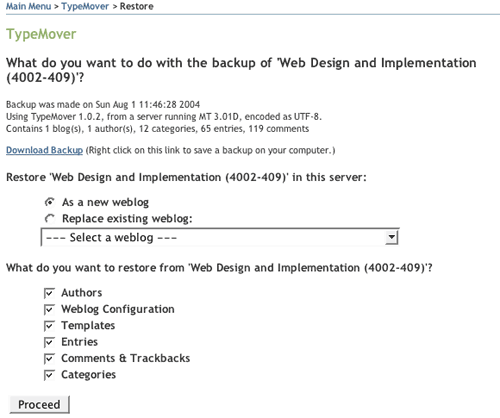
I can also distribute the courseware as an archived backup without entries or comments of any kind, greatly reducing the installation burden for new users. All they’ll have to do is import the single file that I distribute, then make minor editing changes to reflect their content.

The only downside of TypeMover is that it requires an FTP server to be running on the server where your weblog resides. But I can live with that. It’s only an issue for my localhost installation.
So, between TypeMover for cloning blogs, and MultiBlog for coordinating content (announcements and calendars for multiple sections, for example), the courseware should see some nice improvements by the end of the month. I’m glad I stuck with MT through the upgrade storm…these are the kind of improvements that I really hoped we’d see with a new version, and that weren’t immediately apparent when the pricing was first announced.
categories: courseware | teaching | technology
Thursday, 17 June 2004
new revisions to movable type licensing
Late Tuesday night, Six Apart announced yet another revision to the pricing structure for Movable Type 3.0 licenses. The prices are lower, the licenses are less restrictive, and the range of options is far less confusing.
There are now four types of licenses—personal, commercial, education, and not-for-profit. Personal users have three options: free for 1 author and 3 weblogs, a basic supported version for $69.95 that supports 5 authors and unlimited weblogs, and an unlimited personal version for $99.95. This ought to address a lot of the concerns that people raised about the pricing structure (though, of course, it won’t change the minds of people who’ve decided that free-as-in-speech software is a better option for them).
As an educator, I’m particularly happy to see that the educational licenses are spelled out clearly, and that an affordable option for a single professor is included in the mix ($39.95 for unlimited use by one teacher). That will make it much easier for me to continue developing and maintaining my MT Courseware package.
What I’d really like to see for educational use is a TypePad-style interface that allows easy blog creation by users at an educational institution. That would make a big difference in terms of institutional adoption.
categories: on blogging | teaching | technology
Monday, 3 May 2004
teaching new technologies
Most of the time, I really do like my job—I get to teach interesting topics to interested students, and that’s a lot of fun.
There are times, however, when I really wonder why I left behind the relatively stable world of library science for the chasing-your-tail world of cutting edge technologies.
Take, for example, the web-database class that I developed four years ago—not particularly long in most academic lifecycles. At the time, PHP and ASP were the cutting edge technologies du jour, and students came into the class knowing nothing about PHP, MySQL, or ASP.
Over the past several years, a number of factors have signficantly changed the context for the class.
- Students now learn PHP in the web programming class that precedes my class (that class used to be JavaScript and Perl only)
- Students now learn MySQL in their introductory database class
- Component-based technologies like JSP and .NET have emerged as successors to page-based technologies like PHP and ASP
As a result, before I’ve really even solidified the course in its original form, I’m having to learn entirely new technologies and teach to a differently prepared audience. All of which, as any teacher will tell you, is more than a little stress-inducing.
I’ve spent most of the past two weeks trying to re-teach myself JSP, this time incorporating Tomcat 5 and JSTL. The nice part of using JSTL is that it hides all the Java code from me—and since I never did learn to program in Java, that’s a goodness. The downside is the documentation really stinks—I’ve found a ton of web sites, but none of them are clear and direct, particularly when it comes to doing simple database-related tasks.
After four days of banging my head against the code, I’ve finally figured out how to do the simplest of tasks—retrieve several hundred records from a MySQL database and display them ten at a time. Oy.
The future, I think, is to let go of the traditional approach of teaching how to do things in a specific language, and instead offer a more studio-like environment in which students are given access to resources and tools, and then work on developing a project. (We teach most of our classes in “studio mode,” but in most cases they’re far from real studio approaches—they’re lectures with occasional hands-on exercises.) Surprisingly, it’s the students who are often most resistant to this mode of teaching—we’ve successfully conditioned them to see school as a series of core dumps, and switching gears into a more user-directed model often generates resentment and confusion rather than enthusiasm and creativity.
Friday, 23 April 2004
you may ask yourself "how did i get here?"
One of the questions I’ve been asked a lot lately, mostly by full-time academics, was how/why I started blogging. It’s not a quick and easy answer, but I’ve been asked it enough now that it’s probably worth having it here in a public and somewhat permanent form.
My blogging epiphany came about at the Pop!Tech conference in October of 2002. That was the first conference I’d been to with ubiquitous WiFi and a critical mass of people with laptops taking advantage of it, and I was intrigued. What were people doing with their computers, beyond taking notes and checking email? (Turned out that Simson Garfinkel was pulling POP passwords out of the ether, but that’s another story.)
When Dan Gillmor spoke, however, he related an incident that really struck me. Here’s Howard Rheingold’s account of it:
I wasn’t at all familiar with the term “blog” or with the amazing growth of blogging tools and sites, but I was totally intrigued by the feedback loop that Dan had described. And then I realized that everything I was hearing at Pop!Tech was also being blogged by people in the room. (In retrospect, I’d seen this mentioned on the Pop!Tech web site before the conference, but it hadn’t registered as being important to me then.) I started reading the blogs of the people in the room—David Weinberger, Dan Gillmor, Ernie the Attorney. And as I started reading their mediated versions of what I was seeing live, I found that my appreciation and understanding of what I was hearing was deepened and extended. They had different context and knowledge to bring to the topic, links to related sites, personal experiences.
It was a transformative moment for me, particularly when combined with Linda Stone’s brilliant discussion of what she calls “Continuous Partial Attention“—a kind of scanning of multiple open information channels that she was increasingly observing in her students as an adjunct professor. This is not the same thing as multitasking—instead, it’s a constant monitoring, looking for content that makes it worth switching to a focus. (It reminds me of the process that directors of live television events go through…watching a bank of monitors showing different camera angles, deciding which one to bring up as the focal point at any given point in time.)
By the time the conference was over, I was determined to go home and try this technology out on my own. I’d noticed the MovableType link on a number of the sites I’d visited, and I liked the idea of a package I could install and play with on my own server. So upon my return, I downloaded and installed MT into my RIT account, and wrote my first post. (I chose the title mamamusings on a whim, not realizing it would become inextricably linked with me and my online identity; after a year or so of posting to the blog, I finally registered the domain name and transfered my blog off of the RIT system.)
Then I started reading—voraciously. I jumped from blog to blog, soaking up the content and context, thinking about how the medium could be used in my research, in my teaching, in my personal life. I felt very much like Alice down the rabbit hole—it was exhilarating and overwhelming. Along the way, I stumbled upon Joi Ito’s weblog, and noticed he’d posted about a scary “Aspartame is poison” email he’d received. I didn’t know Joi at all, but I commented on his site, and then wrote my own response to his post on my site—my first exposure to trackback technology, since my post automatically “pinged” Joi’s site to tell him that I’d mentioned his post. Much to my delight, this resulted in him visiting my site and commenting on that post—as well as on another post.
Suddenly my experiment in blogging had gone from a monologic to a dialogic form—not only could I “scribble on the walls” of other people’s sites, the walls were talking back. It didn’t take me long to realize how powerful these tools could be in the classroom, so I started making plans to use blogs (MT, specifically) as a context for teaching my upcoming web design class. That first quarter I started with a class blog on which all students had posting privileges, along with having each student create their own blog for posting their in-class exercises and thoughts on the reading. I used that model in my web design class, as well as in my xml class.
In the web design class, the individual student blogs turned out to be an excellent tool for teaching concepts like CSS and CGI. And in both classes, the dialog was greatly enhanced by the appearance in our comments by authors of books and articles we were reading. But the multiple authors on one class blog approach didn’t work well in either class, so I discarded that approach. Instead, over the summer I rethought the role of the course blog, and developed the first version of the MT-courseware I’ve been working on.
I wasn’t just thinking about blogs in my classes, though—I was also thinking a lot about how blogs could help me to make connections in the context of doing research. I felt very isolated at RIT, which is a teaching institution that has only recently started prioritizing research as a faculty activity. It’s very hard to do research if you don’t have a critical mass of people to work with—senior colleagues with research experience in your field, graduate students interested in working in your area. I had neither—so weblogs provided me with a way to build an “invisible college” that could help me develop research-related connections, support, and visibility. Alex Halavais and I experimented with using a blog to record our NSF grant proposal process, which was helpful in many ways (even though we didn’t get funded).
Along with the external links and relationships I was forming, I was also getting a chance to write regularly for the first time since I’d been a graduate student. Having a regular outlet for “thinking out loud” turned out to be extremely valuable to me. I’m a classic “talk it out” extrovert in terms of thought processes, and the blog community I was becoming a part of provided a wonderful context for doing just that. The combination of the informality of lightweight publishing and the immediate distributed peer review and feedback on ideas that blogs encourage was just the right balance for me.
This for me is really the power of weblogs for academics—and often for students, as well. It’s not about weblogs replacing journals, or becoming mass media outlets, or creating a huge personal audience. It’s about finding and maintaining a community of like-minded thinkers—inside and outside of academia—who can be part of an ongoing conversation. As Anil points out, it’s not about popularity, or being at the top of the power law curve. It’s about being part of a community, part of an ongoing conversation.
categories: conferences | on blogging | research | teaching
Saturday, 24 January 2004
burke on grading
In an entry entitled “Wishing I Was Simon, Knowing That I’m Paula,” Timothy Burke does an excellent job of describing the difficulties I’m facing this weekend as I grade student web sites.
RIT doesn’t attract writers with the skill of those at Swarthmore, but it does attract talented web developers. So grading midterm web sites brings up for me the same kinds of dilemmas and questions that Burke raises. He compares the blunt, unsparing honesty of Simon Cowell to the gentler, apologetic approach of Paula Abdul, and concludes:
I watch Simon Cowell and I sometimes wonder if maybe thatís a mistake, wonder if it’s a bad idea to be a Paula. A very select few of the people that Simon dished up abuse towards didnít seem unspeakably bad, and even he observed that a few of them might have careers as singers in bars or local theater or Broadway or weddings. Isnít that another kind of kindness, to tell people that theyíre dreaming the wrong dream? Certainly it wouldnít be kind or right if you knew one of the truly wretched to tell them theyíre great singers or marvelous performers no matter how much you loved them or enjoyed their company. Anybody who has to grade the work of students is running errands for meritocracy, in the end, and it ill-serves us to self-delude too much with gentle words about the dignity and self-worth of all people in all things that they set their minds and hearts to accomplish. But maybe Paula’s the best of both worlds: the meritocracy guarded, while the pain dulled with soothing words.
The whole thing is worth reading. As is most of what Burke writes. I wish he’d ping weblogs.com or blo.gs or blogrolling.com, or create a hand-rolled RSS feed, or something that will tell me when he updates. As it is, I try to remember to stop by there once a month or so to see what he’s got up for me to read.
Monday, 12 January 2004
academic articles on edublogging?
Anybody know of some? I’ll do some digging this week, but I figured I’d tap into the hive mind, too.
If you know of any that are in press (or close to it), I’d appreciate hearing about them, too.
Thanks…
Thursday, 8 January 2004
why i do what i do
It’s cold outside today. Again. Which makes getting up and driving (and walking) through blowing and drifting snow for an 8am web design class not much fun—even for the teacher. <sigh>
And today I was observed, again, for my promotion review. Yes, I got tenure last year. But my department delays the promotion review to the year after tenure (don’t even get me started on what I think about this), so I get to go through two years of documenting and proving myself, including classroom observations.
It was, however, a very good day for being observed. This week is the first week of information architecture unit in the web design class, and these are lectures I really enjoy giving. Tuesday I talked about controlled vocabularies, taxonomies, thesauri, and ontologies, and today we reviewed and operationalized that a bit.
Then I talked about how to do bottom-up organization of a mass of unordered data, and sent them off in small groups to work on a sticky-note-based card sort exercise. There’s a group project for the class, and their design documents are due in less than two weeks, so they’ll be able to fold the results of today’s exercise into their document.
I enjoy doing this exercise, because they really get engaged and involved. It’s fun watching them brainstorm, sort, discuss, debate, and go from an unruly mess of notes on the wall to a rudimentary site architecture. Each group is working on the same topic, so I also get to “shoulder surf” their work, and see the different approaches each group is taking to the material.
I actually remembered to bring my digital camera, and took a couple of pictures of them working in the lab. The first was taken from across the atrium of the building, looking in through the glass wall. The second was taken from inside the classroom/lab, looking out towards the atrium.


Sunday, 28 December 2003
cool geographic aggregator by former student
Not long after I started teaching at RIT, I had my first overachieving student. These are the students that really make me love my job—and keep me on my toes. Ross, a freshman, was already hard at work writing his own XML parser, and had better web coding skills than most of the upperclass students I’d met.
Unfortunately, Ross didn’t stay long at RIT. (And in retrospect, Ross, I feel like I should have worked harder to keep you there.) Once he’d left, I didn’t hear much from him…until I started blogging. Earlier this year, he turned up in the comments of my blog, and I’ve been able to keep track of him a bit on his own blog, Ross Notes.
In his comment on my last entry, he mentioned LocalFeeds in a way that made me think it might be his site. A quick whois lookup confirmed it. Nice job, Ross. I’m glad to see you’re still building cool things in your spare time. :)
And if you haven’t seen LocalFeeds (and added yourself to it), you should. It’s a great way to find weblogs in your geographic area, and let them find you. Tools like this, that begin to blend virtual and geographic communities, are wonderful additions to the social software world.
Monday, 15 December 2003
Monday, 1 December 2003
it's showtime, folks
Twenty-three grad students sitting in the lab across the hall, waiting for me to make my grand entrance.
Caffeine? Check.
Handouts? Check.
Pretests? (Yes, I give a test on the first day. I’m so mean…) Check.
Class web site up? Check.
Butterflies in tummy? Check.
Curtain’s going up…
Wednesday, 26 November 2003
chronicle of higher ed article on weblogs
The November 28 issue of The Chronicle of Higher Education has an article entitled “Weblogs Come to the Classroom.” (subscription required for access)
Increasingly, private life is a public matter. That seems especially true in the phenomenon known as blogging. Weblogs, or blogs, are used by scores of online memoirists, editorialists, exhibitionists, and navel gazers, who post their daily thoughts on Web sites for all to read.
Now professors are starting to incorporate blogs into courses. The potential for reaching an audience, they say, reshapes the way students approach writing assignments, journal entries, and online discussions.
The stuff about weblogs in the classroom is pretty standard fare, though it’s nice to see it finally getting some coverage in the academic press. Unfortunately, it leaves out a lot of the folks in my sidebar who are using (and talking about) weblogs in classes, and doesn’t mention “hub” sites like Educational Blogs and Weblogg-Ed.
There’s some mention of wikis, as well, but the professor quoted (Patricia Pecoy at Furman University, who doesn’t appear to have a weblog of her own…) clearly isn’t aware of a lot of the already existing uses of wiki in educational contexts:
Ms. Pecoy also sees a technology that she says could soon rival blogs — a type of online program called a “Wiki.” As with a blog, users can post comments on a Wiki. But unlike a blog, anyone who uses the Wiki can edit and change any of the posted comments. Such a feature could be useful in Ms. Pecoy’s class, where students could help polish and correct their peers’ French, she says.
“In Hawaiian, ‘wiki wiki’ means ‘quick,’ and this is a quick way to have a collaborative writing project,” she says. “No one I know of is using one yet, but that is coming down the pike next.”
A Google search on “course wiki” yields quite a few hits, including a wiki page that collects links to educational wikis.
Wednesday, 19 November 2003
silly season
There’s something about the grayness of November, combined with the grading of student papers, that causes university teachers go just a little bit insane at this time of year—often with hilarious results. Witness this excerpt from Alex Golub’s “Sample Job Letter”:
While some would balk at the task of attempting to shove even the slightest bit of erudition into a gargantuan classroom full of massive hordes of unwashed, half-asleep freshman, my own experience teaching at [my school] has more than prepared me for this daunting task. Indeed, I have found the experiences fills me with a pleasure which, although it leaves me feeling all dirty inside, I feel compelled to experience again and again. Whether it is demonstrating the location of China on a map, clarifying the non-existence of Dragons, or explaining that the intricacies of TÌang poetry are more than Îthat ching-chong ching-chong talkÌ, my experience teaching has made me realize how vital statues of dead Chinese people dressed in the clothing of extinct ethnic groups are to the course of human history.
Read the whole thing. It’s delightful.
Tuesday, 18 November 2003
"I teach for free; they pay me to do the grading."
What a great quote.
Found in the comments of an Invisible Adjunct post on grading; attributed to someone’s “senior colleague.”
(IA, you need permalinks for your comments. I’m going to post a tutorial on that this week, since it’s easy to do in MT if you know which tags to put into the templates.)
Sunday, 16 November 2003
web design classes
As this quarter draws to a close, I’m already thinking ahead to next quarter’s web design classes. I’m teaching two of them—one undergrad, one grad. They’re very similar, but in the grad class I often take on real-world projects (non profits, preferably) and focus more on the context and users, and in the undergrad class I focus a little more on the back end tech.
The experiment with my MT courseware in my intro class this quarter was moderately successful. Not as interactive as I would have liked, but that’s partly (if not mostly) my fault—I didn’t provide the sparks that might have gotten more of a conversation going.
I used a class weblog in last year’s web design class, and gave all my students authoring capability. This quarter I’m going to keep control of the class blog, but encourage students to use comments and trackbacks (from their own class blogs). I’ll probably set up specific items that are intended for trackbacks—topic-focused posts that encourage aggregation of related resources.
The nice thing about using weblogs in a web design class is that the weblogs are both a communication tool and a teaching medium…as they learn CSS design techniques and backend programming, they apply those to the weblogs they’re using in class.
The ongoing problem in those courses, however, is the tension between wanting to explore conceptual and theoretical aspects of the web environment (from aesthetics to cognition to social impact) and needing to impart specific technical skills.
The pressure for the latter comes from both the students (who at RIT are very career and skill-focused) and the downstream professors in the concentration-level web development courses. The pressure for the former…well, that comes mostly from me. I regularly tell my students that the sign I’ve seen on a colleague’s door in the imaging arts & sciences college—the one that says “Those who know how work for those who know why.”—is more true than they realize.
Saturday, 15 November 2003
setting the record straight
This week’s issue of The Chronicle of HIgher Education has an article on post tenure review here at RIT (subscribers only; email me if you want the full article). It’s a feel-good piece that has our administration all in smiles this week, and most of it is a pretty accurate picture of how post-tenure review was implemented here.
But at the end of the article, in the second-to-last paragraph, there’s a startling discussion with our provost.
Faculty Evaluation and Development grants have also been used to help midcareer, untenured faculty members. When the information-technology department began to grow, the university hired many of its own master’s graduates. A dozen or more of those people are coming up for tenure soon. “Now we are saying they need Ph.D.’s or they will not get tenure,” says Mr. McKenzie. Ten of those professors are currently enrolled in Ph.D. programs at George Mason University. Rochester is paying their regular salaries and giving them significant reductions in teaching, plus $1,500 each for tuition. Some of the professors are exempt from teaching, while others are teaching one or two distance courses. “They are valuable people for us,” says Mr. McKenzie, and worth the investment.
Let’s start with the first problem in this paragraph, the provost’s statement that “Now we are saying they need Ph.D.’s or they will not get tenure.” This came as news to the 14 15 untenured faculty members in our department whose master’s degrees are from RIT. Is this an unreasonable requirement for tenure? Not if it’s communicated to the faculty in question when they’re hired, and reinforced through reviews and support. But it wasn’t. Ever. None of these faculty were ever informed that a PhD would be a requirement for tenure. In fact, they’ve been told on numerous occasions that it would not be a requirement. Imagine their surprise when they read in the Chronicle about this requirement. It’s worth pointing out, as well, that there are some real issues with rewriting tenure requirements on the fly, and doing it only for faculty in one department.
Then there’s the over-the-top, completely false claim that RIT is providing generous support for “those faculty” to pursue doctorates. We have one faculty member, not ten, about to start a PhD program and George Mason. And he’s definitely not getting the attractive package described in the article, not by a long shot. The rest of “those faculty” are teaching 9 classes per year (3 per quarter), which doesn’t exactly give them a lot of time to work on advanced degrees.
The article appeared online on Thursday, and there’s been no official response yet from our administration—departmental, college, or university level. “They are valuable people for us,” the provost says. At the moment, I doubt that’s how they feel.
—
Postscript: A colleague suggests “Master is tricksy” would have been a better title for the post…
Monday, 3 November 2003
controversial professorial weblog
The Chronicle of Higher Education today has an article entitled “A Weblog Starts a Fire,” about the weblog of Indiana University Professor Eric Rasmusen.
Since the Chronicle is subscription-only, here are the lead paragraphs, which summarize the gist of the story:
The trouble began when Professor Eric B. Rasmusen wrote that hiring a homosexual man as a schoolteacher was akin to putting the fox in the chicken coop.“Male homosexuals, at least, like boys and are generally promiscuous,” he wrote on his Weblog, which is resides on the Indiana University at Bloomington’s Web site. “They should not be given the opportunity to satisfy their desires.”
Students and staff members complained about his comments, asking that they be removed from the Web site. Some even suggested that he should be fired. Mr. Rasmusen, a professor of business economics in Indiana’s Kelley School of Business, agreed to remove his blog from the university’s server while officials reviewed the complaints. But it returned a day later, after university lawyers concluded that it did not violate any policy.
Apparently this issue has already been discussed over on The Volokh Conspiracy (where it had its initial beginnings, it seems), and Crooked Timber, though it somehow slipped under my radar at the time.
(Please do not start a flame war in my comments about this, at least not without first reading through the analyses and comments at the two sites mentioned above.)
—-
Just found Daniel Drezner’s post on this topic. Also worth reading.
Wednesday, 1 October 2003
reputation and scholarship
RIT is in the process of a major shift in institutional culture, moving towards a stronger emphasis on scholarship rather than a nearly exclusive focus on teaching. While scholarship has always been mentioned in our tenure policies (see #3), the reality has been that it was the least critical piece. We have full professors in this department who have never published a peer-reviewed article or book, and associate professors who would be hard-pressed to tell you the name of an academic journal or conference in their field of study. The primary criteria for tenure and promotion have traditionally been teaching (with student evaluations weighted very heavily, along with breadth and depth of teaching topics), teaching-related activities such as curriculum development, and service—committee work, academic advising, and activities (like consulting, or pro bono provision of services) outside of the institute.
Over the past several years, our president has been working to change the culture of RIT from a single-minded focus on teaching to a greater blend of teaching and scholarship. On many levels, I’ve felt that this is a good thing. I believe that research and scholarship are critical to keeping the professoriate intellectually alive, and that without it our teaching creeps dangerously close to training. It’s hard to convince students that they should take scholarship seriously if we don’t model that behavior for them.
But while in theory this new approach has great value to all members of the university community, in practice it’s never that straightforward. RIT’s revenue is almost completely tuition-driven. No tax revenues (except for NTID), and not a large enough endowment to provide much breathing room. So every hour that a faculty member doesn’t spend teaching is that much less revenue. And IA will be pleased to know that RIT has really held the line on adjunctification, with a very low adjunct rate and a policy to create non-tenure-track lecturer positions (with decent salaries and benefits) rather than increating the adjunct rate.
As a result, until this year, everyone in my department has taught a 9-course load—three courses per quarter, three quarters per year, most classes with 30 or more students. That doesn’t leave any time at all for scholarship, so to move towards increased scholarship means something had to give.
When the institute passed new scholarship guidelines last year (here, in section 5), based in large part on Ernest Boyer’s reformulated scholarship definitions from Scholarship Reconsidered, it opened up an opportunity for our faculty to renegotiate teaching expectations. As a result, we’re about to implement a new “portfolio” approach that will require untenured faculty to take a “blended” approach—teaching 7 courses per year, and in exchange doing a specified amount of scholarship.
But in that “specification” lies the problem. It’s difficult to specify scholarship in discrete quantities, and to operationalize those specifications effectively. It’s particularly difficult for faculty hired before this shift began, but who are not yet tenured—and there are a lot of them. Between 1988 and this year our department grew from 18 to 51 faculty, and only 20 of us are tenured. Many recent hires were brought on because of their teaching skills, or their experience in the IT industry. Only nine of them have PhDs. Fifteen of them received their master’s degrees from RIT, where our focus is on preparation for industry careers, not academic careers.
Now we’re saying to these folks that the rules have changed. When we hired them, we said teaching and service were really all that mattered. Now we’re saying they have to be scholars, as well. And while we’re providing fairly broad guidelines for what constitutes scholarship (it’s not just academic journals and conferences), we are expecting them to be able to figure out what scholarship is.
What’s happening, alas, is that most of them are seeing the scholarship emphasis only as a bean-counting exercise for tenure and promotion, rather than as an opportunity (facilitated through lower course loads) to expand their intellectual and creative abilities. And as a result, the focus seems to be on process rather than product, quantity rather than quality. To someone who’s not familiar with scholarship, there’s no difference between Academic Exchange Quarterly and Harvard Educational Review. Both are peer-reviewed, therefore both are “beans” to be counted and put into the tenure jar.
As I was driving home today, I was trying to think about how to explain the difference between these to someone putting together their plan of work for the upcoming year. The key concept that’s missing from our scholarship documents and implementation plans is reputation. It’s not just that something is peer-reviewed. There’s more value to the faculty member, and the institute, and to our students, in my being asked to be a speaker at SuperNova than in my being asked to speak to the local PTA. There’s more value in my publishing an article in Wired than in publishing one in the local free-at-the-grocery-store computer rag. There’s more value in exhibiting my work at SIGGRAPH than in putting it up on the college web site. It’s not that there’s no value in those secondary options, but if I have to focus my energy on one or the other, the choice is clear.
Reputation is hard to quantify, and it’s particularly difficult in a field like IT, which spans so many traditional disciplines. And it’s even more difficult when you (quite appropriately, I think) expand the boundaries of “scholarship” to encompass a broader range of activities. But at the end of the day, scholarship really is about reputation. In a professional field, your “peers” may not be editors of academic journals—they may be other programmers, artists, or even bloggers.
I don’t know how we’ll solve this. I hope that we’ll eventually come through this transition period and get to a point where our faculty see scholarship as an opportunity rather than a burden. I wish I could convey to more of them how much joy I take in the research I’m doing, or how good it feels to get an invitation to speak at a conference. But I don’t know how to bridge the cultural gap, to help them make that difficult shift from teachers to scholars. And I fear that if they don’t bridge that gap—and quickly—there will be trouble aplenty when our “bubble” hits the needle of the tenure process in two years.
Monday, 29 September 2003
the last gangstory
I’m not big on crime stories, fictional or documentary. So when Weez recommended Gangstories, I shied away from it. The weblog was wonderfully written, powerful autobiographical stuff…but it was too far away from my world for me to own it, and too dark for me to want to.
When D (the author) ended Gangstories last week, however, my curiousity was piqued. “Email me if you want the last story,” he wrote in his last entry. How could I not?
What I got back from him was something that bridged the gap between his world and mine. I’ve read his “last story” several times now. It’s something I’ll save, and read again. And again. Because it’s a story of hope, a story of reclamation, a story that makes me remember that what I do as a teacher can make a difference in ways I may never know.
Thanks, D.
Friday, 19 September 2003
they like me! they really like me!
Was talking to my mother last night. She teaches in the Language and Literature department at RIT, so it’s not unusual for us to have some of the same students—sometimes at the same time, but more often during different quarters.
She used to teach at a local community college, where she once had a student who’d left RIT after his teachers had apparently failed to recognize his skills and talents. In the compare-and-contrast essay that her students wrote that semester, this person compared the worst teacher he’d ever had with the best. The best, of course, was my mother. The worst…well, while the person wasn’t named, my mother realized after reading it, and discussing it with the student, that it was me. (My mother and I don’t share a last name, nor are we similar in appearance, so he’d have had no way of knowing about the connection.)
In a remarkable display of professional ethics, my mother never told me who the student was, and never told the student who I was. But the incident stuck with us both, and we now regularly tell the story to our students at the beginning of a quarter, so that none of them unwittingly make the same mistake.
At any rate, I was talking to her last night, and she mentioned that she had a student this quarter who’d had me for a class last year. And that when the student found out about the relationship, she stopped my mother after class to talk about how much she’d loved my class. In fact, my mother said, the student said that it was the best class she’d taken here at RIT.
I know, I know, this is a shameless, self-promoting, boastful post. But I’ve posted a lot lately about things that that I’m not happy about…seemed like it made sense to share something that made me happy.
Monday, 8 September 2003
mt courseware update
I’ve recruited two other faculty members to test the MT courseware this quarter, and we’re in the process of locating and squashing various bugs. Turns out I made a number of things more difficult than I needed to, so I’m streamlining as I go.
Nevertheless, initial results are encouraging. Students are using the comment feature—not just on entries where they’re required to post (like “Introductions”), but also on other entries, like the assigned readings. I have a good feeling about all this.
I expect that by the end of this quarter, I’ll have a better version of the courseware available, complete with documentation. As one of my colleagues said, right now it isn’t plug-and-play, it’s more like plug-and-shock.
However, now that the initial configuration headaches have eased, it is remarkably easy to maintain and add to the site. And MT’s templating features make it easy to repurpose information—for example, putting the “instructor information” in the syllabus as well as the sidebar.
One thing I’m considering is finding a student next quarter to help me write an installer of some kind for implementing the courseware in a more automated way. It may only be doable in a mySQL backend environment…I’m not sure yet. But it would be nice for folks not to have to go in and do all the template creation and category addition by hand.
Thursday, 4 September 2003
and so it begins again
The kids trudged reluctantly up the steps of their school bus this morning. I trudged just as reluctantly into the basement and onto the treadmill, which ended up being a lot more fun than the rest of my day. Presidential address to the university community (two hours long, made slightly less painful by my discovery that my new 17” powerbook was capable of picking up a wifi signal even out in the giant tent in U Lot), college faculty meeting (don’t even get me started on the pointlessness of that gathering), student convocation (which I skipped in order to rush home and meet my kids as they got back off the bus), and finally a master’s student project defense.
On the one hand, I’m happy to get back into some semblance of a routine. I eat better (fewer temptations) and exercise more (because it’s part of my daily schedule) during the school year. But on the other hand, it only took a few hours for me to remember how much I hate the part of my job that’s not teaching or research—the endless hours of faculty and committee meetings that balkanize my days and cause constant frustration in all the participants.
Skipping convocation was my little declaration of independence, in a way. It’s not that I don’t like convocation…there’s a part of me that really loves the pomp and circumstance surrounding convocation in the fall, and commencement in the spring. The formal welcoming and leave-taking, focused on the students. But going to convocation today meant missing my kids’ arrival at home on their first day of school, and I wanted to make statement—to myself and to my family—about where my priorities would be this year. Now that I’m tenured (as of September 1st), I don’t have to worry that missing a “required event” will cost me my job. So I went home, and was sitting on the front porch when the bus pulled up in front of the house.
The freshman students won’t remember that I wasn’t at convocation today. But my kids would remember if I wasn’t here when they got home. It was the right thing to do.
Tomorrow I’ll try to clear my mind of the meeting-induced negativity I accumulated today, and will start to focus on the grant work (we give our first presentation to the new students tomorrow, asking them to support our work by agreeing to participate) and class preparation. I’ve got a full section of freshmen in my Intro to Multimedia class, and I’m really looking forward to that. It’s a great chance to connect with students when they first arrive, and to shape their perceptions of the department and the university.
categories: curmudgeonly | family | kids | teaching
Saturday, 30 August 2003
my worlds
Via Matt Kirschenbaum, this lovely essay entitled “What Does a Professor Do All Day, Anyway?”
It ends with these paragraphs:
What’s the common denominator, then, in what professors do all day? Translation. We translate from a field of knowledge to people who want to know about it. In my case, I translate between the people of today and the people from the past of the United States. Other professors translate physics, or business, or languages, or other cultures. We all live in at least two worlds. One of those worlds is a world of ideas, of print and numbers, a world almost limitless and impossible to master, growing every time we turn our backs. The other world is the immediate and human world of classes, committees, office hours, deadlines, budgets, advising. Without being a citizen of both worlds, an active participant in both worlds, we are diminished, our ability to teach diminished. The dichotomy between teaching and research is no dichotomy at all if we understand that a professor journeys back and forth between two worlds, translating among many people. All in all, it’s not as embarrassing or boring as you might think, especially when your students see fit to give you an award for doing what you love doing all day anyway.
Amen.
Wednesday, 27 August 2003
professorial ethics and boundaries
Elouise and George have written a bit lately on the issue of students reading professorial blogs, and on professor/student relationships generally.
Like Chuck (who commented on Elouise’s post), I find that I’m not entirely comfortable discussing this topic in a forum where I know that students are regular readers and participants. I think, however, that there’s real value in a community of colleagues discussing these questions.
So, I thought I might set up a private forum somewhere (where? I don’t know. I’d love an alternative to Yahoo! Groups for mailing list or forum capability, but I don’t know of a good one off the top of my head) for this discussion. If you’re interested, let me know (ell/at/mail/dot/rit/dot/edu), and I’ll “include you in.”
Sunday, 3 August 2003
we have met the enemy and he is us
(That’s one of my favorite Pogo quotes of all time. So glad I’ve found a way to use it as a post title.)
Sam Ruby points to a wonderful post by Phil Ringnalda entitled “There is No They.”
What Phil describes—the “small town” feel of weblogging where change is effected by “us” rather than “them”—is a big part of why I like using weblogs in classes. I’m often asked by colleagues why I don’t just use the conferencing tools already available to me—the Prometheus-based courseware, the FirstClass conferencing system, etc. The reason is that when I use weblogs in a class, we become a part of the big small town that is the technical weblogging world. The example I like to use is how Shelley Powers, author of the new O’Reilly book Practical RDF, stopped by our XML class weblog to comment on students’ posts when we talked about RDF and metadata.
When you know that the author of the book you’re discussing may be reading your posts, and may stop by to debate with you, it has a significant impact on the tone and content of the discussion—and that influence is primarily positive.
(As I was writing this post, Anil Dash [of Six Apart] commented on my last post about TypePad. An excellent example of exactly what I’m talking about! Knowing that Anil and others in the technical development community read this blog keeps me honest in my comments and criticisms, because I know I’ll be called on it if I’m out of line!)
categories: on blogging | social software | teaching | technology
proud mama
It really is back-to-school season. I’ve spent the weekend working on course materials, and my older son just cleaned out his backpack. (“Mom! Look! The missing SandwichKeeper!”) I told him to toss any papers that he didn’t want to save, and he pulled out one and nonchalantly said “I don’t really care about this, but you might want it.”
It’s just a short “research report” on the rainforest, typed on the computer and then printed out. But I have to say, it’s pretty sophisticated writing for an 8-year-old. (He’s 9 now.)
We need to save the rainforest for many reasons. One is that there will be less runoff. The trees will hold the soil so the rain does not wash away.Another reason is that we will lose oxygen. The trees will take in less carbon dioxide, and they will breathe out less oxygen.
Another reason we should save the rainforest is that there will be more droughts if we do not. The humidity will stop and the dry wastelands will contribute to the global warming so there will be more droughts.
The final reason that we should save the rainforest is that we will not find all the new species. There may even be a plant that can cure cancer, but it will probably be destroyed before we discover it.
This is why we should save the rainforest.
I read it, then say to him “Wow. This is really good. Where’d you find all this stuff out?” “We did research.” “So, did you mostly just copy the stuff you found?” “No. That would be cheating. I did the research, then wrote it in my own words.”
I just wish that more of my 18-year-old freshman students at RIT (a) wrote this clearly, and (b) had such a clear grasp of academic ethics.
Thursday, 31 July 2003
collaborative learning and institutional culture
There have been a few interesting posts lately about collaborative learning. Many of them spout the relentlessly cheerful “we tried it and it was amazing and I wish more teachers would shift their paradigms because the students love it so much” line. (Hmmm. Perhaps my frustrations are already leaking through, eh?)
Happily, Seb Paquet pointed me to Martin Blanche’s post on “Obstacles to collaborative learning.” (Permalinks are broken, alas, so go to his main page for now.) I’ll take the liberty of quoting them here:* Students and lecturers are more familiar with a knowledge-transmission model of education and don’t always understand what is expected of us in a more constructionist environment. * We have too little information about lecturers’ and students’ backgrounds, networks and skills - so often we don’t realise that there is somebody in the group who could teach the rest of us a lot about some aspect of what we’re studying.One of his readers, Antje, added a few more:
* No or very limited mechanisms for students to talk back to the lecturer and (especially) to talk to one another.
* Inadequate ‘course memory’. Lecturers often are the only bridge for this year’s students to the knowledge created by last year’s group - students don’t get to see what last year’s group did. There is no mechanism for students who want to stay in the group after the course is officially over (and who could be a useful resource for next year’s students) to do so.
* Knowledge level of participants (if they come from different educational backgrounds and models they may have different experiences with education, different subject knowledge and different attitudes towards learning)
* Motivation (collaborative learning needs a great deal of personal motivation, a quality not very much present in a goal-oriented (degree hunting), immediate-satisfaction-seeking (fast-food …) society which we are more and more becoming. Motivation pre-supposes the need or urge to WANT to know and to WANT to make an effort … found, unfortunately, in a small percentage of humans)
* Personal characteristics (inrovert / extrovert / confidence levels). many students may want to contribute but are afraid of making mistakes or afraid of being patronised. others are unsure how exactly to contribute (collaborative learning does not instruct on how to use collaborative learning skills and can easily end up being an unstructured, anxiety-provoking lassez faire situation)
* Integration (integration of new and traditional learning approaches should be the aim rather than collaborative learning ‘in place of’ traditional teaching style models (and I guess Martin sees it that like I do). A combination will allow the student to weigh both aspects and become over time more accustomed to the s(often more frightening) approach of collaborative learning at his / her own speed.”
As I read through these, nodding my head in recognition, it occurred to me that there are probably significant variations in student (and faculty) receptiveness to these new paradigms across both academic disciplines, and academic institutions. At RIT, I’ve encountered a great deal of resistance—from students, not colleagues or administrators—when trying to move to more participatory, collaborative learning. I suspect that this is a function of both the technical nature of the field, and the institutional culture (which is fed by the $21K/yr tuition rate). Students are often resentful and critical when they feel they “aren’t getting their money’s worth” out of a class. Many of them feel entitled to lectures, whether or not they facilitate learning outcomes.
Perhaps I need to find more innovative ways to convince them of the value of a paradigm shift, but with 3 courses per quarter, 3 quarters per year, and an average of 30 students in each class, I’ve been hard pressed to innovate at that level. This year may be better. We’ll see.
Tuesday, 22 July 2003
what's wrong with courseware
Well, that’s a grandiose title. Sorry. I am not going to try to provide a complete courseware critique here. I’m just thinking about one thing that bothers me about the courseware we use at RIT (and which is true of most courseware systems)—it’s closed. Nobody but the students can see it.
Makes sense for grades, of course. But not for anything else. For years, I’ve kept syllabi online for my classes—which has helped not just my students, but also professors and students from other classes and schools, and people not affiliated with schools at all. It was “open source” information.
Now, RIT wants me to put all my course information into the proprietary courseware system that they’ve invested significant funds into. The problem is, it locks it all away. Not only does that not provide any benefits to my students, it has a negative impact on the overall identity of RIT by hiding what we do best—teaching.
MIT has the right idea, I think, with its Open Courseware project. Because it’s not the syllabus that’s the real value in your educational experience. It’s the guidance and support and encouragement and feedback that a good teacher provides. It’s the realization that maybe you don’t know everything already, and that constructive criticism from your professor might be more valuable than angry criticism from your boss or your client. It’s the opportunity to watch how others around you tackle a project, and learn from their successes and failures. It’s the social components, not the information components, that provide the most important lessons. (Which loops right back around to Joi Ito’s recent post about the primacy of context over content.)
So I’m not going to use the courseware this fall for my freshman multimedia class. I’m going back to my old(er) method of standard web-based distribution. (Yes, I know there are some broken queries in there. I’m working on it.) But I’m adding to that a class blog. And maybe…just maybe…a wiki, as well. We’ll see.
Friday, 13 June 2003
what do teachers make?
Via Loren Webster, this wonderful poem by Taylor Mali:
What Teachers Make, or You can always go to law school if things don’t work outHe says the problem with teachers is, “What’s a kid going to learn
from someone who decided his best option in life was to become a teacher?”
He reminds the other dinner guests that it’s true what they say about
teachers:
Those who can, do; those who can’t, teach.I decide to bite my tongue instead of his
and resist the temptation to remind the dinner guests
that it’s also true what they say about lawyers.Because we’re eating, after all, and this is polite company.
“I mean, youπre a teacher, Taylor,” he says.
“Be honest. What do you make?”And I wish he hadn’t done that
(asked me to be honest)
because, you see, I have a policy
about honesty and ass-kicking:
if you ask for it, I have to let you have it.You want to know what I make?
I make kids work harder than they ever thought they could.
I can make a C+ feel like a Congressional medal of honor
and an A- feel like a slap in the face.
How dare you waste my time with anything less than your very best.I make kids sit through 40 minutes of study hall
in absolute silence. No, you may not work in groups.
No, you may not ask a question.
Why won’t I let you get a drink of water?
Because you’re not thirsty, you’re bored, that’s why.I make parents tremble in fear when I call home:
I hope I haven’t called at a bad time,
I just wanted to talk to you about something Billy said today.
Billy said, “Leave the kid alone. I still cry sometimes, don’t you?”
And it was the noblest act of courage I have ever seen.I make parents see their children for who they are
and what they can be.You want to know what I make?
I make kids wonder,
Let me break it down for you, so you know what I say is true:
I make them question.
I make them criticize.
I make them apologize and mean it.
I make them write.
I make them read, read, read.
I make them spell definitely beautiful, definitely beautiful, definitely
beautiful
over and over and over again until they will never misspell
either one of those words again.
I make them show all their work in math.
And hide it on their final drafts in English.
I make them understand that if you got this (brains)
then you follow this (heart) and if someone ever tries to judge you
by what you make, you give them this (the finger).
I make a goddamn difference! What about you?
Sunday, 25 May 2003
free at last, free at last!
Classes are over, grades are submitted, only a few more days of meetings next week. I can feel myself unwinding—it’s almost tangible. Physical tension melting away along with the mental. During the school year, there’s a constant monkey on my back—the feeling that there’s always a little bit more I ought to be doing. More student (or committee, or colleague) mail I should read and respond to. More attention paid to the grading of projects. More effort in the preparation for classes. More time spent answering questions. Falling asleep becomes a nightly battle to banish those “do more” demons.
The June following my first year as a professor, I remember sitting out on my back deck with my husband. As we sat there looking at the newly-planted garden, and the kids on the swingset, I realized that this job bears a strong resemblance to a very, very old joke: “Why are you banging your head against the wall? Because it feels so good when I stop.”
Yes, academia is filled with petty politics and outrageous stresses. But there are many joys associated with this job—some of which were reaffirmed yesterday during commencement. Shaking the hand of each student (hundreds of them) after they crossed the stage and received their diploma (well, their diploma case) is a wonderful feeling. Hugging the many of them whose lives I know I’ve touched—and who have in turn enriched mine—is even better. All my resentment of academia’s ills fades away when a student comes up to me during the line-up for the commencement processional and says “I want you to know that your class had the most impact on me here—it made me realize what I wanted to do, and that I could do it.” Or when a parent says “He’s told me so much about you, and I’m so grateful for all the support you’ve given him while he was here.”
So the school year ends—as it always does for me—on a note of gratitude and hope, and the summer stretches out in front of me…three months of relaxed schedules, time with my family and friends, and intellectual energy freed up to devote to my upcoming grant research (more on that later this weekend). Oh…and blogging, of course.
Thursday, 1 May 2003
an afternoon with the public printer
Okay, so it’s not quite “dinner with Larry Lessig,” but today I spent some time with the US Public Printer, Bruce James. In addition to overseeing the US Government Printing Office (GPO), he’s the president of RIT’s Board of Trustees. He brought about a dozen members of his management team along, as well. Our department was their last stop on the tour, so I didn’t expect they’d be paying a lot of attention after a long day of touring.
I was in for a surprise. I talked about our new XML course sequence, which got approved today by our grad curriculum committee. (Well, the first three courses; I still have to write the fourth.) It includes an Intro to XML course that focuses on DTDs, schemas, metadatas, and general XML concepts, an XML Transformation & Presentation course that covers XSLT, XSL-FO, XPath, XPointer, and XLink, and an XML Programming course including tools for parsing XML, and web services approaches. The last course will be a “Semantic Web Seminar” where students will tackle a real-world information problem and develop an XML-based solution.
They really got it. They were scheduled for a half hour with us, but stayed at least an hour, asking questions, making suggestions, and appearing genuinely supportive and enthusiastic about the curriculum. I think we’ll be talking more about partnerships—which is really exciting. I think there will be some great co-op opportunities for our students, as well.
On a side note, I was the only woman in the room. Me, three male colleagues, and (at least) a dozen male GPO executives. Hmmm.
Monday, 31 March 2003
trackback example (for students)
My colleague Steve Jacobs is having his students in the “Writing for Interactive Multimedia” course use blogs this quarter. Several of them seem to be struggling with trackback, so I’m using this post to (a) point them to Ben & Mena’s new trackback tutorial, and (b) link to their posts so that they see a trackback in action.
So, Lauree, Kunal, Keith—here’s a ping in your direction. If you’ve got “allow pings” turned on in your blog preferences, this should result in a trackback to your entries.
If you want to test the process in reverse, you’ve got two options. First, you can make sure autodiscovery is turned on in your blog config, and simply link to the permalink for this post (http://www.it.rit.edu/~ell/mamamusings/archives/000406.html). MT should automatically determine the trackback URL. Alternatively, if you didn’t want to link to the post, but did want it to register a trackback, you could put the trackback URL (http://www.it.rit.edu/~ell/mt/mt-tb.cgi/395) into the “URLs to ping” box at the bottom of your entry screen.
the glue factory
From today’s dive into mark:
In the future, there will be so much open source software available, programmers will be judged by how much they know about it and how well they can glue it together to build solutions.
Yes!! That’s exactly what I want us to be teaching our students—undergrad and grad. We’re well on our way already with the courses we already offer, but we’ve still got room to grow in this regard.
Thursday, 13 March 2003
weblog tool projects
Today I had two different graduate students come to me with ideas for blog-related graduate capstone projects (an alternative to theses for our students). How cool is that?
It looks like the first one is going to work on multiple authoring issues associated with Movable Type. Ideally, I’d like a way to create an MT blog that has almost Wiki-like “add yourself as an author” capability. I’d also like a way to easily select among “simple” and “advanced” editing/authoring interfaces. Anybody know of things already happening in this arena?
The second is going to work on a kids’ interface to MT blogging. My 8yo, Lane, has expressed interest in blogging—but the standard MT entry environment is not particularly kid-friendly. I’d like a kid-focused interface that keeps things really simple, preferably integrating some of the functionality that plug-ins like MT-Textile offer, but also giving a UI that’s really kid-friendly (and kid-tested).
After too many years of supervising yet-another-ecommerce-project, it is incredibly exciting to have students who want to work on the things I really care about. And because our students take classes in everything from programming to database to HCI, we have an incredible opportunity to turn them loose on the LazyWeb and have what they do help the larger social software community.
I’ve waited a long, long time to get to a point where my personal and professional interests intersected so well, and in a way that has long-term professional potential. I have to keep pinching myself these days. :-)
On the not-quite-such-good-news front, my cholesterol test results came back, and it looks like it’s a very good thing that I’ve made myself publicly accountable on the exercise front. Need to change the diet, too, it seems. <sigh>
categories: on blogging | research | teaching | technology
Monday, 10 March 2003
open source courseware
I have spent most of this weekend wrestling my course materials into the proprietary courseware framework that our university has invested in. The system, called Prometheus, boasts what may be the all-time worst user interface I’ve had the displeasure of working with in many years.
I’m taking the time to do this because, in my experience, criticism of a bad system is only taken seriously when the person doing the criticisim has made a good-faith effort to learn and use the system. So I’m using our Prometheus-based “myCourses” system to support both of my classes this quarter—one on-campus, one distance-learning.
So far, we’re off to a bad start. Simple things that I ought to be able to do aren’t possible at all—from moving a reading from one course meeting slot to another, to creating custom dropboxes for file submissions. The labels for sections and tasks are counter-intuitive, and the entire system seems to have been designed without regard for the user’s needs (at least the faculty user…we’ll have to see what my students say). While some of the Prometheus system is apparently customizable by “IT Administrators” at a given school, none of it appears to be customizable by the actual people who have to use it. I can’t make it less ugly. I can’t fix the UI problems. I have almost no control over the look-and-feel, which is a very large part of the overall “online classroom” experience.
It’s the equivalent of being asked to teach all my classes in a dark, dingy basement classroom, with no control over lights, desk locations, etc. Sure, the “institution” has the ability to change it. But as the instructor, I don’t. Blech.
What’s worse, however, is that I realized after I was done that there’s no way for me to make any of the course information publicly accessible—something I’ve always done with my syllabi. While there are some aspects of the courseware—like the testing and grading functions—that should be private, those are the exceptions. I resent using a system that won’t let me share the basic information about the class with anyone who’s interested.
Last year, I started building a PHP/mySQL system to generate my syllabi. You can see it in action with my web database, xml, and web design syllabi from earlier this year. But I can’t show you this quarter’s thesis prep or intro to multimedia courses, because they’re hidden inside our proprietary system.
Why isn’t there an open-source courseware package that’s as easy to use and customizable as something like Movable Type??? Is that so very much to ask? I did some poking around tonight, and didn’t find anything that really excited me. This is not rocket science…it’s a customized content management system (CMS) application. People make them all the time.
(Interestingly, Prometheus started out as home-grown “community source” software at GWU, but was purchased by Blackboard, a commercial competitor.)
Is there something great out there that I don’t know about? If so, I’d love a pointer. And if not, I guess I need to start fleshing out my little homegrown system, and looking for people to work with me on it to make it more robust and usable in multiple contexts.
categories: curmudgeonly | research | teaching | technology
Friday, 7 March 2003
academic debate
Have enforced a cooling-off period for myself on this topic…will respond this weekend to some of the comments, but I’m not sure there’s much that’s new to say at this point.
However, for those who have been following the discussion, here’s a link to an interesting relevant article from The Chronicle of Higher Education, entitled “Opting Out of Academic Science.” Stories. I like stories. They show us a more multifaceted world—one where broad labels for entire groups of people (“academics,” “politicians,” “bloggers”) just don’t work.
Actually, the whole “Career Network” section of the The Chronicle is full of stuff related to this recent debate. Another one is “The Two-Year Attraction,” about the growing number of people choosing to work in community colleges rather than 4-year institutions.
Update:
Oh, one more, specifically addressing the explotation of adjuncts, something that Invisible Adjunct raised in his/her comments here. “All Right Already, We’re Exploited.”
Monday, 3 March 2003
why bother?
I’ve avoided responding to Dorothea’s continuing self-described “rampage” against academia, because I suspect that nothing I write will change her well-entrenched negative view of academia. Clearly, Dorothea’s got some “issues” on this topic—not just her grad school experience, but her experiences with her father, as well.
But hey, I’m an extrovert. I think out loud. So I’ll respond, but not in a point-by-point attempt to rebut each of her assertions. You see, I don’t disagree that her view is in some ways accurate. I just don’t think it’s complete. Academia, like every other human-constructed environment I’ve ever seen (from the nuclear family to the nation-state) can be ugly or beautiful, depending on your own context and experience.
I feel particularly compelled to counter Dorothea’s assertion that “survivorship bias” is tainting my view. In fact, she might want to consider reading my dissertation. The topic? A qualitative (“Sense-Making”) inquiry into attrition in doctoral programs in my field. (And what field might that be? Library & Information Science—the same field in which Dorothea has recently been accepted into a graduate program. Which makes me wonder how she can say things like “Deeply sick and sad system. IÌm so glad IÌm out of it for good I couldnÌt begin to tell you,” with a straight face…).
I went into the project fully expecting to hear angst-ridden tales of woe from those who’d left their doctoral programs. In fact, that was the exception rather than the rule. Most of the people I interviewed had few regrets about their departure from doctoral work. They’d tried it, found it not to be what they wanted, and moved on.
It was necessary for me to do a great deal of related reading and research into graduate and doctoral attrition, and one of things that really became clear during this process was how very different the environments were from field to field. The experiences of a doctoral student (or a professor) in biophysics are extremely different from those of a sociologist, or a library scientist, or a literary theorist. And beyond that, the experiences of a student in any of those fields will vary significantly based on the country in which they study.
All of which by way of saying, it’s not the specifics of Dorothea’s complaints that I question. It’s the broad brush she uses to paint an entire world of teachers, students, and scholars—based solely on personal anecdotal experience.
categories: curmudgeonly | research | teaching
Tuesday, 25 February 2003
misinterpretations and misunderstandings
I shouldn’t post anything when I’m in the throes of grading because it’s sure to be misunderstood. :-)
But I feel I must respond when Dorothea posts about what she sees as the horrible effects of academia on my otherwise right-thinking brain: ” And yet the system has warped them such that they both get a twinge when somebody else comes out with a perfectly good idea, just because they didnÌt come out with it first.”
I’m pretty sure that’s not what I said in my post. What I did say was that I found myself “torn between excitement and envy,” and that I wished I’d had more time over the past few years to explore the topics that I had been so interested in as a grad student. The twinge isn’t that somebody else came up with the idea first—it’s that I want to be able to contribute more to the body of knowledge on the subject than I’ve been able to do.
All my bitching and moaning about academic politics aside, I wouldn’t trade my job for any other. Academia has its warts, sure…and those are what get most of the attention. What gets left out are all the reasons that so many of us work so hard to get here…and to stay once we’re here. So, let me list some of those.
- Autonomy. In no other job I’ve ever had (including working as an entrepreneur) have I had the amount of autonomy I have in this job. I get to define what I teach, and how I teach it. What matters is results—if my students are learning, if I’m demonstrating scholarship. Not how I get there. That’s totally up to me.
- Flexibility. Not only do I get to decide what and how I teach—for the most part, I also get to decide when. If I need to be home to meet my kids when they get off the bus two days a week, I can schedule my classes and office hours to accommodate that. If I want to be home for bedtime every night, or at the gym every morning—no problem.
- Collegiality. I work with a bunch of incredibly smart, incredibly dedicated people. I never lack for someone to have coffee or lunch with, or someone to go out for a beer with on a bad day. If I want help solving a problem—instructional, technical, theoretical—there’s someone only steps away ready to help.
- Students. This is big. There is nothing—nothing at all—like the feeling of seeing your students grasp a concept and run with it. Today I spent two hours watching my Web Design students present their final projects. They were fabulous. Check out this, and this, and this. How cool is that? Those of you who are parents have some idea of what this feels like…but I get it all the time, almost every day, and I get paid for it.
- Creativity. There aren’t too many jobs out there where you’re encouraged to write about things you really care about. My job rewards me not just for the traditional academic stuff, but even for this blog.
- Summer. The summer after I started teaching, I remember sitting outside on my back deck, looking at my garden, thinking that this job felt a bit like that old joke “Why are you banging your head against the wall?” (Answer: “Because it feels so good when I stop.”) Now that I’ve acclimated to the annual workload, summers are an incredible blessing. Not only do I get to share them with my family—travelling, swimming, playing—I also get to spend time thinking, imagining, exploring new ideas for teaching, and…if I can get my intellectual act together this year…even writing.
I know Dorothea had a terrible experience her last time through graduate school. But I guess I take umbrage at the characterization of academia as such a wicked, evil place. It’s not. It’s full of people like me, Alex, Jill, Larry Lessig, and a host of others (many still sans blog). And it has no more of the evil, backstabbing, wrong-thinking type of person than any other work environment I’ve been in—from corporate to non-profit.
Thursday, 13 February 2003
ming the mechanic on education
Just discovered Flemming Flunch's weblog ("Ming the Mechanic"). He's got a great post this week discussing the problems with education generally, and technology education specifically. Here's a sample, but read the whole thingc.
I realized some horrible things about education some years ago when it was part of my job to hire computer programmers. I hired a dozen or so programmers over several years. To do that, I had to look through the stacks of thousands of applications we'd gotten, and I needed to interview hundreds of people and pick the ones to hire. And a disturbing picture quickly started forming. Very often, the more advanced a degree the person had in Computer Science, the more hopeless it was to expect them to program anything real. Well, generalizing is dangerous, so let me point out that I'm talking about those who didn't have real jobs as programmers while they were studying, and who didn't spend all their sparetime programming video games. And, don't get me wrong, there are some really useful things on the curriculum in Computer Science, which all programmers really ought to know. What I'm talking about is the people who just went through the college courses and exercises and exams, hoping to be great computer scientists, hoping they'd have a career once they were done. If it were just a Bacherlor's degree, there might be some hope that they could actually program, and that they might apply some of what they learned. If it was a Master's degree, it was probably too late. And the clerk in the store where we bought our computers, he had a Ph.D. in Computer Science, the poor fellow.The point is that here we have some people who've worked hard for years, and they've learned to get things *mostly* right, who've learned that if they get 80% of the questions right, they're doing well. If they can regurgitate what the textbook says, and make their answers look about right, they do well in school. They've been thoroughly trained and validated into doing things that look sort of right, but which aren't.
Tuesday, 11 February 2003
academic/disciplinary power struggles
Last year, RIT established a new "College of Computing and Information Sciences," taking three departments that had previously been part of a large and heterogeneous college ("Applied Science & Technology") and putting them together under one roof (courtesy of funding from Paychex founder and perpetual gubernatorial candidate Tom Golisano).
One of the things that is happening as a result of the new college formation is growing battles over the valule of various curricular aspects within the departments, and the value of the departments themselves.
Ever the historian (A.B. in History from Michigan, '84), and the librarian (M.L.I.S. from UM, '87), I decided tonight to poke around a bit on the subject of academic politics, disciplinary boundaries, and other related topics. Too often at RIT we seem to think that we are unique in the world, and fail to look outside our boundaries for examples of how others might have handled similar problems.
Didn't take long to find something relevant. Seb Pacquet pointed to the work of Brian Martin on higher education. Martin's book "Tied Knowledge: Power in Education," which is available in full-text on his site, had the following gem in chapter 4:
At the Australian National University, I witnessed long battles between pure and applied mathematicians for control of departmental prerogatives. This included denigration of the other side's talents and activities, appointment of supporters, encroachment on course content to steal the middle ground, and inability to agree on allocation of resources to proposed common courses. Claims about the definition of a 'mathematician' were used to exclude appointments or promotions to those too far from the conception of the key power-brokers. In this struggle, the ideological resource of the pure mathematicians is the autonomy of their knowledge from other departments and thus the prestige of pure mathematics as a 'higher knowledge' than other disciplines. Applied mathematics, to the extent that neighbouring disciplines overlap with it, is harder to establish as a separate knowledge base. Hence in a struggle with pure mathematics, applied mathematicians instead can form alliances with neighbouring disciplines such as theoretical physics and computer science. The outcome of battles between pure and applied mathematicians will depend on the balance between the advantages to pure mathematicians given by greater internal control over knowledge in the discipline and advantages to applied mathematicians given by the interests and demands of related disciplines. The intrinsic political advantages to pure mathematics are such that in many universities applied mathematics does not exist as a separate department, and the subject matter of applied mathematics is taught in the departments of physics, biology, psychology and other areas where mathematics is applied.
Amazing how well this fits the current conflicts occurring between my department of information technology (an "applied" area), and our sister departments of Computer Science and Software Engineering.
Monday, 27 January 2003
more pedagogical happiness
From another student:
I started blogging because my class for Web Design required us to create individual blogs, modify them using CSS, and post in them. Then I discovered I like tweaking the blog, adding new features - sort of like upgrading a toy that will not stop improving. My desire to write has expanded to new heights. I used to write in diaries, short stories, about interesting things occassionally.
Funny...the quality is really spotty in this year's work. Half are really bad, the other half are really good. Not much middle ground. Either they took it seriously and really got into it, or they blew it off completely. <sigh>
grading gratification
Grading is not an enjoyable aspect of teaching. Am gutting my way through the last of the web pages I need to finish grading for tomorrow, and came across one students post on web standards:
[...] at the same time they must know the rules to break the rules.
That's really the point, but so many of my students seem to miss it. It's gratifying to see it appear on a student blog.
Tuesday, 14 January 2003
girls and computers
Dave Winer pointed to a NY Times article from Sunday entitled "Where the Girls Aren't," and chose the opening line as his quote:
Anyone who has ever tried to pry a girl offline knows that girls like computers. They just don't understand how they work.
Ack! Okay, I'm as aware as anyone of the shortage of women in the profession, especially after years of fewer than 10% women in my classes, and writing a grant proposal this year to try to understand and address the problem. But still--that quote sticks in my craw.
So I read the rest of the article, and felt better. For example, they talked to a woman who's been teaching math in high schools for 30 years:
''When I started in 1972,'' she said, ''there were three girls in calculus out of a senior class of about 50. Now there are three sections of Advanced Placement calculus, in a class about the same size -- in other words, about 75 percent of the senior class. This would not have happened if we had bought into the reigning mantra of the time, which was, 'Boys are naturally interested in mathematics; let them do it. Girls are more talented in literature and history; why ask them to change?' ''
I remember taking AP Calculus in 1979. I had been in advanced math classes every year in high school, and since at the time the school systems wouldn't let you take calculus 'til senior year, during junior year I took the two half-year courses offered to advanced students--Abstract Algebra in the fall, and Matrix Algebra in the spring. They were both taught by a teacher who managed to systematically weed out most of the girls in the class by the end of the year. He would humiliate girls in the class, ridicule them when they answered questions wrong, ignore them when they were right, and regularly tell us that we really weren't cut out for studying math. (Years later, I heard that same teacher was fired after his affairs with male students were discovered. No big surprise there--plenty of us had seen him taking students on "dates" to hockey games. As Dave Barry would say, I am not making this up.)
I stuck it out through junior year, and enrolled in his AP Calculus class senior year. I lasted half the year. When I got my early acceptance letter from Michigan, I realized that I could live with the automatic "F" I'd get from withdrawing from the class more easily than I could live with the class. So I quit. It was only the second time my parents had to go to the school on my behalf (the first time is worth another blog entry at another time).
That wasn't really the end of it, though. The experience left me thoroughly convinced that I wasn't good at math. And that became a self-fulfilling prophecy--I barely made it through the required calc class in college, and avoided anything that looked like math or science. (This from someone who in her junior year of high school was convinced she was going to be an industrial engineer.) It wasn't until after my master's program, when I started thinking about a PhD, that I finally faced up to my math fears and conquered them. Turns out I'm pretty good at math after all. But it took fifteen years to undo the damage that one teacher caused.
So how much damage is done every time we assume that "girls aren't interested" in how computers work? How much of that comes from the early conditioning, the toys we give our children, the activities we encourage them to get involved in? Cub scouts build pinewood derby cars to race, learning physics and geometry in the process. (My kids are racing theirs on Saturday.) But do Brownies? Probably not.
Uh-oh. I'm starting to rant. Time to sleep.
categories: gender | teaching | technology
Wednesday, 8 January 2003
rethinking our graduate program
I'm part of a group of people in our department who are beginning to rethink our graduate program, and where it could/should go. It began as a "career-changers" program, because there were no undergraduate programs in IT for it to build upon. But as we--and the field--have matured, there's a growing need for in-depth, graduate level study in more focused areas than what our current program offers.
So the question becomes what, exactly, we want to be teaching. And along with that, what are we best at? And what students do we want? And who will their employers be? And what will those employers expect? Lots of questions, really. But lots of enthusiasm about exploring them.
We've got a number of areas that we're particularly enthusiastic about exploring, many of them related (directly or indirectly) to what many people seem to be calling "social software." We've got lots of strength in HCI, information architecture, XML, web development, game programming, VRML, multi-user media spaces, etc. So how can we knit that into a coherent graduate program?
So, faithful readers, what do you think? What kinds of graduate programs are missing right now? What niches need to be filled? What kind of program would you want to hire someone out of? What kind would you want to attend yourself if you could? I'd love to leverage the expertise of the blogosphere on this question, especially right now during the formative stages of this discussion...
updated 4:40pm
Dorothea asks in her comment for a pointer to our current program. Should have thought to include that to begin with. We've got a "purpose and goals" page, as well as a list of courses in the program. Also, fwiw, here's one to our faculty "research interests."
categories: big ideas | teaching | technology
Monday, 6 January 2003
by any other name...
My lecture tomorrow morning on Information Architecture will begin with a recitation of Juliet's speech from Romeo and Juliet. I learned it in high school (didn't everybody have to commit a Shakespearean soliloquy to memory at some point in their education?), and can still rattle it off at will.
What's the connection? Naming, of course. Do names matter? If so, how? That will be the primary topic of discussion. We'll also discuss product categories on the Lego site, which always stirs up some interesting conversations.
I always look forward to this class--more than any other lecture I give, it brings together my library and web backgrounds, and lets me push my students into thinking a bit more than I usually require them to do.
Thursday, 19 December 2002
Success!!!
One of my students writes in her blog:
I'm really surprised how much I've figured out with CSS just today trying to make this blog look cool.
This is exactly the kind of enthusiastic exploration of the technology that I had hoped would happen if I used blogs as the centerpiece for teaching web technologies.
Meanwhile, on other fronts, people like Shelley Powers and Simon St. Laurent have been reading and commenting on my XML class's blog. What a nice note on which to start my winter break...
Monday, 9 December 2002
more conference/classroom cogitation
So today Aaron Swartz has a post in his weblog on "How to Run a Good Conference." Once again, I find myself thinking about what happens when you substitute "classroom" for "conference," "students" for "audience," and "teachers" for "speakers"...
1. Speech is a bad medium for communicating information. (This one is due to Tufte.) Speech can't be stopped and rewound, it can't be carefully examined, it can't be slowed down, it can't be paused, it can't present complex concepts, and it's really very low bandwidth. Just use paper. Tufte suggested giving the audience a bunch of paper that communicated the important information and have them read through it before hand.2. Speech is a good medium for dialog. (Also due to Tufte.) Speech is best used for interaction. Are you sure that's correct? Have you seen this? Why didn't you go this way? Smart people love discussing things with other smart people, especially when the others are informed (see point 1). Let them!
Every conference I can think of gets these two things backwards. They use valuable face-to-face time for worthless presentations by people who are not particularly entertaining and even if they were are saying things you already know, and then try and stifle discussion (one question per person, sir!) and shunt it off towards lunch or something (we don't have time for questions now). Hello? What did all these people come out here for? I can watch infomercials at home just fine, thanks.
3. Get smart people and encourage them to talk. Now this one is a bit difficult. Most conferences seem to use a large mass of "normal" people (the "audience" to subsidize the "special" people (the "speakers"). Since I tend to be in the latter group and don't have much money, I sort of like this. But the annoying side-effects are that "special" people don't get to discuss things with each other and "normal" people waste everybody's time by asking stupid questions. I'm not sure how to solve this. Maybe only let "special" people ask questions? I suspect this would seriously hurt the feel of the event.
decentralizing course content?
From the conference blog for SUPERNOVA, this post on "Decentralizing the Conference" had some resonance for me in thinking about the classroom experience. What happens when we substitute "classroom" for "conference" in this paragraph? (This is the same thought I kept having at Pop!Tech this year...)
I'm convinced, though, that distributed online communications can enhance physical events. Many conferences ban blogging, or refuse to provide any live coverage on the Web. The theory is that any public exposure will make people less likely to pay the registration fee. I think that's short-sighted. If prospective attendees aren't convinced of the value of the conference, no amount of hiding the content will help.
We'll see if the class blogs I've set up for my Web Design and XML classes add value by decentralizing content...
Monday, 2 December 2002
distractions
My husband and I spend a lot of time telling our sons to "stay focused." On breakfast, on finding their shoes, on finishing their homework...they're forever being distracted from the task at hand.
While it drives them nuts, the alternative can be worse--as I'm finding out today. Nobody told me to stay focused during this appallingly short break I've been on. So tonight I find myself frantically building syllabi in anticipation of tomorrow's classes.
It's not that I haven't taught these classes before. But as I've noted earlier, I'm revising my teaching approach pretty significantly, including the use of blogs as a teaching tool. Not only will the students be blogging their readings and interesting site finds, but we'll be installing and customizing Movable Type so that they learn CSS, SSI, .htaccess, etc in a concrete context.
The concept is fine, but it requires a shuffling of topics and presentation. Which then invalidates my previous schedule of assignments. Which then requires a rethinking of the assessment process. The more time I spend on this, the more time I realize it's taking. But I really do feel I should have a relatively accurate syllabus when I walk in the door of the lab tomorrow at 8am--it's a contract between me and the students, and the basis for their decision as to whether or not to stay in an early morning class during a Rochester winter.
Meanwhile, the XML class looms at 4pm tomorrow. But I think I can get through the first meeting of that with less trouble. (Famous last words...?)
So blog entries and blog reading have dropped to the bottom of the priority pile for the short term. I'm missing it already!
Friday, 22 November 2002
in search of beautiful syllabi
My online syllabi are serviceable, but far from stunning. A tad embarassing, really, since I supposedly teach aesthetic as well as information design, and I should be paying more attention to the "user experience" of my students.
There are plenty of business web sites for me to look at for design ideas, but very few well-designed academic sites that I've been able to locate. Anybody out there with suggestions for good examples of online syllabi? Not training classes, but academic classes...with course outlines/schedules, readings, assignments, grading criteria, links to student work, blah blah blah.
I've hit designer's block on this, and need to be pointed towards academic eye-candy to get unstuck. [geez, does that sound like an oxymoron, or what?] I'm not looking for school or department sites, or for professor's personal sites. Just syllabi.
Thanks in advance for any links you can provide.
(suggestions as to functionality, content, and/or bells-and-whistles that you've seen and liked on syllabi are solicited as well)
Sunday, 17 November 2002
why am I doing this?
E-mail today from a favorite student. (Names removed to protect the innocent...and the irretrievably stupid. 'Xxxx' is the student; Yyy is the boss.)
You'll never guess what one of the boss' told me the other day... I wrote them a proposal for something that they asked for and he came back to me at my desk and said, "Xxxx, as Yyy and I's net-worth goes up you need to use smaller words and simpler sentences. This is too hard to read. Make this paper into a bulleted list." No joke. Isn't that insane?
<sigh> Makes me wonder if there's really any validity to the things I tell my students about communication skills and grokking the big picture. Maybe I have become too cloistered in my ivory tower to understand the world they have to work in. Maybe while I sit in my office, the entire outside world has remade itself using Dilbert as a blueprint.
Blech.
Saturday, 16 November 2002
immersive experiences
Halley Suitt has been blogging about Harvard's "digital identity/branding" conference the past two days. I particularly like this post, which gets to the key issues that trouble many faculty about the whole distance learning push on campus.
The president of Harvard, Larry Summers dropped by to open this conference. I was particularly intriqued by one issue he brought up. He described all the benefits of watching a football game in your living room -- good seat at the 40 yard line, instant replay, comfortable couch, 72 degree temperature, clean bathroom easily available, etc. and then the unfavorable conditions in a stadium -- usually poor, distant seating, no instant reply, hard bench, freezing conditions at time, dirty bathroom at the end of a long concrete ramp. He asked, "What is the nature of an attractive experience?"In other words, why the heck would anyone attend a football game? What attracts people to a group experience? What is it that makes a shared classroom experience better? Is there something irreducible about an in-person classroom experience? (Most of us believe there is.) What is it about distance learning that just doesn't cut it? Where do the digital and the in-person experiences compliment one another? Do they conflict?
It's not just what attracts people to a group experience...you can have a "group experience" where a whole bunch of folks watch that same football game together in your living room, and still you can wish to be there in the cold, in the end zone, part of that experience.
I thought about this a lot after PopTech. After all, why go to PopTech? Everything's streamed after the fact. You can watch it at your leisure, replay the bits that went too fast, even project it on the wall and invite your colleagues over.
The easy answer is the interactions before/after/between speakers, the 'networking.' But that's not it for me. I enjoy meeting folks there, but what I really love is somewhere in that opera house shared experience. The whispered conversations with the people sitting around me. The conversations that carry over from the opera house to the hotel to the dinner table. It's the total immersion in the experience, unencumbered by the other aspects of my life at the periphery.
That last bit may be the crux of it. When I was finishing my dissertation, I found I only got real writing done when I removed myself physically from the environment where other work needed to be done. The total immersion was necessary, critical, vital to the process. Perhaps the best experiences have to be.
Thursday, 14 November 2002
blogs as college teaching tools
As this quarter winds down, I'm thinking about how to fold my rekindled enthusiasm for web-related technologies into the two courses I'm teaching next quarter--Web Design & Implementation for undergrads, and a seminar in XML for the Web (undergrads and grads).
Group and individual blogs seemed like a no-brainer concept, but I've had a hard time finding them used effectively in higher ed contexts.
Then today, I saw a mention on grumpygirl's blog that led me to a blog that was clearly written by a student whose professor was talking about web design. The problem? As grumpygirl notes, the student provides no contact info, and no link back to a class site.
Not to be deterred, I change into my alter-ego, the technolibrarian. (Cue music. "Ain't no info lost enough, ain't no details obscured enough, ain't no meta tags bad enough, to keep me from finding more about you..."). A search in Google on Jessica's user ID and her teacher's last name (which she's helpfully mentioned in a post) yields quick results. She's apparently a student in in Charles Lowe's Writing About Digital Culture class at Florida State.
My first assumption was that it would be a technology course, but it's not. It's a freshman comp class! How cool is that? Geez, my freshmen would love a class like this. I need to find a way to open a channel of communication with the Language and Lit department at RIT about this. (Luckily, my mom teaches there. How convenient. :-)
From the syllabus:
First-Year Writing courses at FSU teach writing as a recursive and frequently collaborative process of invention, drafting, and revising. Writing is both personal and social, and students should learn how to write for a variety of purposes and audiences. Since writing is a process of making meaning as well as communicating, FYW teachers respond to the content of students' writing as well as to surface errors.[ . . . ]
In this class, we will be exploring many aspects of digital culture, including virtual communities, the history of the internet, creating hypertext, open source, artificial intelligence, blogging, etc. We will read Snow Crash, a cyberpunk sci-fi novel, and use the novel as a jumping off point for exploring directions that technology will take us in the future, as well as how these changes will impact society. We also will read many articles from the web which discuss some of the subjects listed above. And you'll be encouraged to expand your research to explore aspects of digital culture not covered in this class. Since this is a writing class and because learning about digital culture also means being an active participant, we will make heavy use of the class web site and every student will keep an individual weblog, or "blog."
Excellent. Must e-mail him asap to find out how the blogging is going in that class.
Tuesday, 12 November 2002
we're hiring
Yes, it's true. Nobody else in the technology world is saying that these days, but we do have a position open in our department here at RIT.
PhD not required, MS (or MA, or MFA...) is. Ability to see IT holistically ("computing in context") important. High tolerance for chaotic environment, eccentric colleagues, and cold winters necessary. Take a look at our courses to get a broad sense of what we teach; take a look at our faculty to see the range of people and backgrounds who teach here. (And no comments about the piss-poor web site, please; I had no hand in its design.)
It is, in fact, an excellent place to work. Rochester is a surprisingly livable city, particularly good if you've got kids--schools are excellent, cost of living is outrageously low (you SoCal types would cry if you knew what I paid for my house), art and culture are pervasive. Excellent wine is within an hour's drive.
And just think how cool it would be to have people introduce you as "the professor."
If you're interested, send me mail. (If you can't find my address without my linking it here, you probably aren't the right person for the job, anyhow.)
--------
ps one more particularly nice perk for those with kids; faculty--and their immediate family members--get free tuition at RIT.
Wednesday, 6 November 2002
research informing practice
Why does it seem so difficult to convince teachers that research has a role in informing their daily practice? This has always been an issue in librarianship, too. A frequent topic of discussion (and frustration) in the hallowed halls of academia. Never a good answer or a solution. We talk past each other instead of to each other. We need to find common ground for communicating ideas. Theory and practice have to inform each other, on an ongoing basis, for progress to be made.
<sigh>
Tuesday, 5 November 2002
doc searls to world: "start a blog!"
Doc Searls has a great post today, entitled "Cause your own effects," in which he discusses giving advice to someone with career woes. What does he say they should do? Start a blog, of course.
Anyway, I was responding to this guy's request by email when I decided to cut the last line and paste it over here. Ü You can be the pinball or you can be the pinball machine. With a blog you can create your own machine.
Yes, yes, yes! That's exactly why I want to change the way I (we?) teach web design. I want to stop teaching them how to be pinballs in the corporate web machine, and start teaching them how to create their own machines.
Monday, 4 November 2002
blogging as a research tool
The only good thing about being sick is that it gives me carte blanche to lie on the couch and blogsurf.
Was playing around on Allconsuming, which led me to Jill Walker's blog. She's working on her doctorate at the University of Bergen (Norway), and has some great papers on her site related to blogging. Personal Publication as an Online Research Tool is good. Even better is a paper she presented at the June 2002 ACM Hypertext conference, called Links and Power: The Political Economy of Linking on the Web. The abstract for the latter is short and sweet:
Search engines like Google interpret links to a web page as objective, peer-endorsed and machine-readable signs of value. Links have become the currency of the Web. With this economic value they also have power, affecting accessibility and knowledge on the Web.
Jill also has a link to a post on "nomadic writing" written by her friend (and "blog cluster" neighbor) Adrian Miles.
My blogroll is taking over my life.
Saturday, 2 November 2002
defining a discipline
I've been asked by a group of senior colleagues in our department to participate in a discussion group to help define the nature of our emerging academic discipline.
IT is the perpetual "Rodney Dangerfield" of the academy, generally dismissed as "applied computing." But those of us involved in it know that it's far more than that. We grew out of CS--and HCI, and Instructional Design, and Information Science, and Communication, and MIS--but we're not just "applied" versions of any of them. We go deeper into mechanics than many of the more theoretical fields we draw on, but we focus more on the context of computing than the applied fields.
Our faculty come from a wide range of backgrounds (from Computer Science to Library Science to Chemistry to Philosophy to Education and beyond), and teach in a wide range of areas. We have concentrations in networking & systems admin, learning and performance technologies, web application development, multimedia development, database design & administration, application programming, and more. Our students learn both the how and the why, and not just in a business context.
So, what are we? Right now, the process of defining that is a bit like the blind men and the elephant. We're each focused on our own piece, and while we know that they must be connected, we don't really understand the whole. That's what this discussion group is going to try to do. Can we come up with an effective description of what we do (beyond "contextual computing," which is what I usually call it, for lack of a better term)? Can we develop formalisms to describe the underpinnings of our field?
Or will it turn out that there's "no there there," that we're not in fact a discipline, but rather a collection of teachers and classes that can't coalesce around a meaningful core?
In our first discussion, we all seemed to agree that just as bioinformatics can be traced to a signficiant event/discovery (the human genome project), IT can probably be traced to the point where internetworking reached the desktop, and the graphical web was born. We're not just the study of the Internet, but almost everything we do revolves around the 'net in some way. But what does that mean in terms of defining our underpinnings?
I'm looking for good readings for our group to use as think pieces--things that talk about the changes in technology (and perhaps the study of technology) since the early 1990s. Suggestions welcome.
Thursday, 31 October 2002
staying real
My kids are out trick-or-treating tonight. They left filled with that same sense of wonder that I remember from my childhood..."you mean all I have to do is ring someone's doorbell and they'll give me candy???" I love seeing them so happy, enthusiastic, optimistic. It gives me hope.
And it makes me realize how very, very lucky I am to live somewhere where my children can safely go door-to-door, where I know my neighbors and trust them, where someone down the street can take my kids out into the night without causing even a flicker of fear in me. Important to remember that, especially when I get caught up in the frustrations of daily life and academic politics.
I value the online communities that I'm involved with, but I'm not nearly as dependent on them for my (and my family's) well-being as I am on my physical community. I don't see that as being likely to change in the foreseeable future. Nor do I want it to.
I was thinking about that as I was post-processing this year's Pop!Tech (more on that this weekend, after I get this $%^& NSF grant proposal done). Every year they put streaming video of the conference up on the net after the conference is over. Between that and the real-time blogging, why do I need to go? Because the real connections and energy that happen in the opera house during and between presentations is every bit as important as the content being presented. They feed back on each other.
That's what makes me so certain that "distance education" will never completely replace what we do now on campus. The ability to deliver information will improve, and the quality of virtual campus communities will improve, as well. But that won't replace the environment that a good teacher--and a responsive class--can build in a brick-and-mortar classroom. I know there are DL proponents who would argue with me about that...but much as I love and thrive in virtual communities, I simply can't see them replacing the physical classroom in entirety.
css extravaganza
oooooooo.....
Followed a link from Scott Andrew's blog to Meryl's list of over 900 blogsites that are laid out with CSS and no tables (except for tabular data, natch). Woohoo! This is what I loved about MT when I first looked at it, and it's going to be a wonderful way to teach the power of CSS to my students next quarter.
Tuesday, 29 October 2002
teaching programming in context
Have been thinking a lot about how we teach technology, especially programming. University of British Columbia built a very cool "Virtual Family" game-like program for teaching Java to undergrads, which seems like it's exactly the way we need to go. Then one of my students showed me Terrarium, a really cool tool for learning .NET.
We need to do more of this. We need release time so that we can do more of this. We need to care about doing this. We need to tell people when we do this.


